


The Generic Manipulation Driver Package - Implements a ROS Interface over the robotics toolbox for Python

Overview

Armer Driver

QUT Centre for Robotics Open Source License: MIT Build Status Language grade: Python Coverage

image

Armer documentation can be found here

image

Armer aims to provide an interface layer between the hardware drivers of a robotic arm giving the user control in several ways:

In addition to a multiple control method layer, Armer is designed to be a compatability layer allowing the user to use the same code across different robotic platforms. Armer supports control for physical and simulated arms giving users the ability to develop even without access to a physical manipulator.

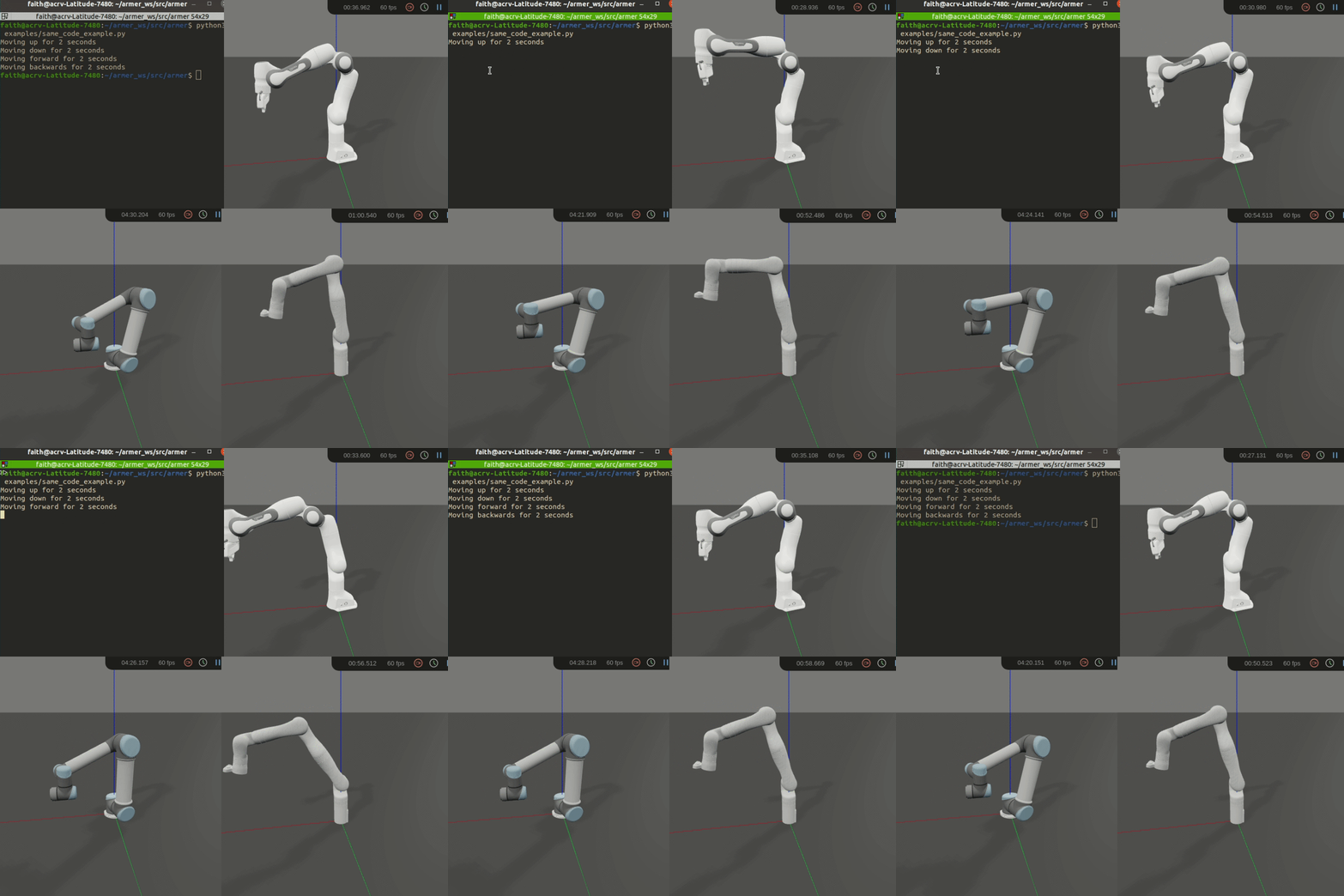
Below is a gif of 3 different simulated arms moving with the same cartesian velocity commands.
image

Requirements

Several ROS action servers, topics and services are set up by Armer to enable this functionality. A summary of these can be found here.

Armer is built on the Python Robotics Toolbox (RTB) and requires a URDF loaded RTB model to calculate the required movement kinematics, RTB comes with browser based simulator Swift which Armer uses as an out of the box simulator.

Due to these supporting packages using Armer with a manipulator will require several requirements:

Software requirements

Robot specific requirements

  • ROS drivers with joint velocity controllers
  • Robotics Toolbox model

Installation

Copy and paste the following code snippet into a terminal to create a new catkin workspace and install Armer to it. Note this script will also add the workspace to be sourced every time a bash terminal is opened.

sudo apt install python3-pip 
mkdir -p ~/armer_ws/src && cd ~/armer_ws/src 
git clone https://github.com/qcr/armer.git && git clone https://github.com/qcr/armer_msgs 
cd .. && rosdep install --from-paths src --ignore-src -r -y 
catkin_make 
echo "source ~/armer_ws/devel/setup.bash" >> ~/.bashrc 
source ~/armer_ws/devel/setup.bash
echo "Installation complete!"

Supported Arms

Armer relies on the manipulator's ROS driver to communicate with the low level hardware so the the ROS drivers must be started along side Armer.

Currently Armer driver has packages that launches Armer and the target manipulator's drivers are bundled together. If your arm model has a hardware package, control should be a fairly plug and play experience. (An experience we are still working on so please let us know if it isn't.). Below are the github pages to arms with hardware packages. Install directions can be found on their respective pages.

For more information on setting up manipulators not listed here see the Armer documentation, Supported Arms.

Usage

The Armer interface can be launched with the following command:

roslaunch armer_{ROBOT_MODEL} robot_bringup.launch config:={PATH_TO_CONFIG_YAML_FILE} sim:={true/false}

After launching, an arm can be controlled in several ways. Some quick tutorials can be referenced below:

For more information and examples see the Armer documentation

Owner
QUT Centre for Robotics (QCR)
A collection of the open source projects released by the QUT Centre for Robotics (QCR).
QUT Centre for Robotics (QCR)
[NeurIPS'21] Shape As Points: A Differentiable Poisson Solver

Shape As Points (SAP) Paper | Project Page | Short Video (6 min) | Long Video (12 min) This repository contains the implementation of the paper: Shape

394 Dec 30, 2022
An algorithmic trading bot that learns and adapts to new data and evolving markets using Financial Python Programming and Machine Learning.

ALgorithmic_Trading_with_ML An algorithmic trading bot that learns and adapts to new data and evolving markets using Financial Python Programming and

1 Mar 14, 2022
WatermarkRemoval-WDNet-WACV2021

WatermarkRemoval-WDNet-WACV2021 Thank you for your attention. Citation Please cite the related works in your publications if it helps your research: @

LUYI 63 Dec 05, 2022
Code for the ICML 2021 paper: "ViLT: Vision-and-Language Transformer Without Convolution or Region Supervision"

ViLT Code for the paper: "ViLT: Vision-and-Language Transformer Without Convolution or Region Supervision" Install pip install -r requirements.txt pip

Wonjae Kim 922 Jan 01, 2023
Pytorch code for our paper "Feedback Network for Image Super-Resolution" (CVPR2019)

Feedback Network for Image Super-Resolution [arXiv] [CVF] [Poster] Update: Our proposed Gated Multiple Feedback Network (GMFN) will appear in BMVC2019

Zhen Li 539 Jan 06, 2023
Created as part of CS50 AI's coursework. This AI makes use of knowledge entailment to calculate the best probabilities to win Minesweeper.

Minesweeper-AI Created as part of CS50 AI's coursework. This AI makes use of knowledge entailment to calculate the best probabilities to win Minesweep

Beckham 0 Jul 20, 2022
9th place solution

AllDataAreExt-Galixir-Kaggle-HPA-2021-Solution Team Members Qishen Ha is Master of Engineering from the University of Tokyo. Machine Learning Engineer

daishu 5 Nov 18, 2021
A two-stage U-Net for high-fidelity denoising of historical recordings

A two-stage U-Net for high-fidelity denoising of historical recordings Official repository of the paper (not submitted yet): E. Moliner and V. Välimäk

Eloi Moliner Juanpere 57 Jan 05, 2023
Code for "PVNet: Pixel-wise Voting Network for 6DoF Pose Estimation" CVPR 2019 oral

Good news! We release a clean version of PVNet: clean-pvnet, including how to train the PVNet on the custom dataset. Use PVNet with a detector. The tr

ZJU3DV 722 Dec 27, 2022
Multi-query Video Retreival

Multi-query Video Retreival

Princeton Visual AI Lab 17 Nov 22, 2022
WHENet - ONNX, OpenVINO, TFLite, TensorRT, EdgeTPU, CoreML, TFJS, YOLOv4/YOLOv4-tiny-3L

HeadPoseEstimation-WHENet-yolov4-onnx-openvino ONNX, OpenVINO, TFLite, TensorRT, EdgeTPU, CoreML, TFJS, YOLOv4/YOLOv4-tiny-3L 1. Usage $ git clone htt

Katsuya Hyodo 49 Sep 21, 2022
Using Python to Play Cyberpunk 2077

CyberPython 2077 Using Python to Play Cyberpunk 2077 This repo will contain code from the Cyberpython 2077 video series on Youtube (youtube.

Harrison 118 Oct 18, 2022
A PyTorch Toolbox for Face Recognition

FaceX-Zoo FaceX-Zoo is a PyTorch toolbox for face recognition. It provides a training module with various supervisory heads and backbones towards stat

JDAI-CV 1.6k Jan 06, 2023
Predicts an answer in yes or no.

Oui-ou-non-prediction Predicts an answer in 'yes' or 'no'. It is based on the game 'effeuiller la marguerite' in which the person plucks flower petals

Ananya Gupta 1 Jan 15, 2022
Official PyTorch implementation of Less is More: Pay Less Attention in Vision Transformers.

Less is More: Pay Less Attention in Vision Transformers Official PyTorch implementation of Less is More: Pay Less Attention in Vision Transformers. By

73 Jan 01, 2023
Code of the paper "Part Detector Discovery in Deep Convolutional Neural Networks" by Marcel Simon, Erik Rodner and Joachim Denzler

Part Detector Discovery This is the code used in our paper "Part Detector Discovery in Deep Convolutional Neural Networks" by Marcel Simon, Erik Rodne

Computer Vision Group Jena 17 Feb 22, 2022
NAACL'2021: Factual Probing Is [MASK]: Learning vs. Learning to Recall

OptiPrompt This is the PyTorch implementation of the paper Factual Probing Is [MASK]: Learning vs. Learning to Recall. We propose OptiPrompt, a simple

Princeton Natural Language Processing 150 Dec 20, 2022
Customer-Transaction-Analysis - This analysis is based on a synthesised transaction dataset containing 3 months worth of transactions for 100 hypothetical customers.

Customer-Transaction-Analysis - This analysis is based on a synthesised transaction dataset containing 3 months worth of transactions for 100 hypothetical customers. It contains purchases, recurring

Ayodeji Yekeen 1 Jan 01, 2022
Facilitating Database Tuning with Hyper-ParameterOptimization: A Comprehensive Experimental Evaluation

A Comprehensive Experimental Evaluation for Database Configuration Tuning This is the source code to the paper "Facilitating Database Tuning with Hype

DAIR Lab 9 Oct 29, 2022
[ICCV-2021] An Empirical Study of the Collapsing Problem in Semi-Supervised 2D Human Pose Estimation

An Empirical Study of the Collapsing Problem in Semi-Supervised 2D Human Pose Estimation (ICCV 2021) Introduction This is an official pytorch implemen

rongchangxie 42 Jan 04, 2023