A PyTorch port of the Neural 3D Mesh Renderer

Overview

Neural 3D Mesh Renderer (CVPR 2018)

This repo contains a PyTorch implementation of the paper Neural 3D Mesh Renderer by Hiroharu Kato, Yoshitaka Ushiku, and Tatsuya Harada. It is a port of the original Chainer implementation released by the authors. Currently the API is the same as in the original implementation with some smalls additions (e.g. render using a general 3x4 camera matrix, lens distortion coefficients etc.). However it is possible that it will change in the future.

The library is fully functional and it passes all the test cases supplied by the authors of the original library. Detailed documentation will be added in the near future.

Requirements

Python 2.7+ and PyTorch 0.4.0.

The code has been tested only with PyTorch 0.4.0, there are no guarantees that it is compatible with older versions. Currently the library has both Python 3 and Python 2 support.

Note: In some newer PyTorch versions you might see some compilation errors involving AT_ASSERT. In these cases you can use the version of the code that is in the branch at_assert_fix. These changes will be merged into master in the near future.

Installation

You can install the package by running

pip install neural_renderer_pytorch

Since running install.py requires PyTorch, make sure to install PyTorch before running the above command.

Running examples

python ./examples/example1.py
python ./examples/example2.py
python ./examples/example3.py
python ./examples/example4.py

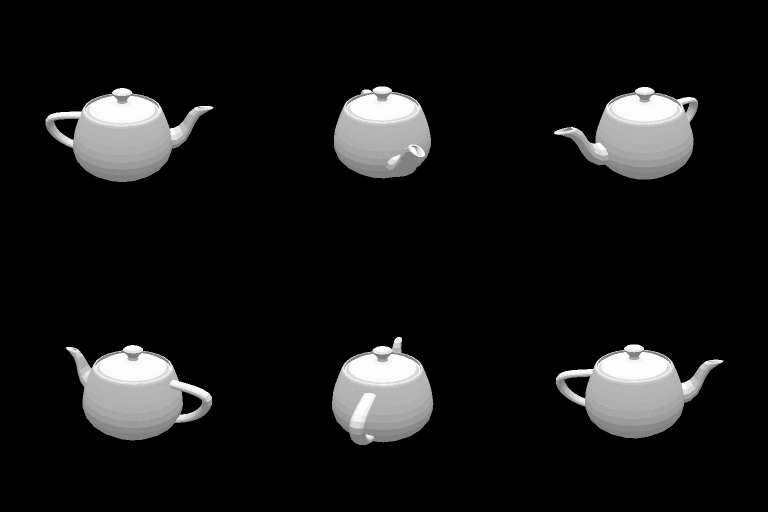
Example 1: Drawing an object from multiple viewpoints
Example 2: Optimizing vertices

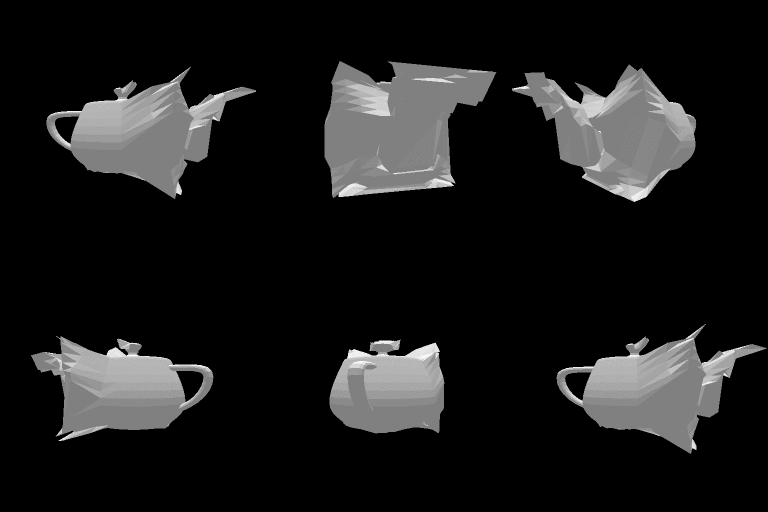
Transforming the silhouette of a teapot into a rectangle. The loss function is the difference between the rendered image and the reference image.

Reference image, optimization, and the result.

Example 3: Optimizing textures

Matching the color of a teapot with a reference image.

Reference image, result.

Example 4: Finding camera parameters

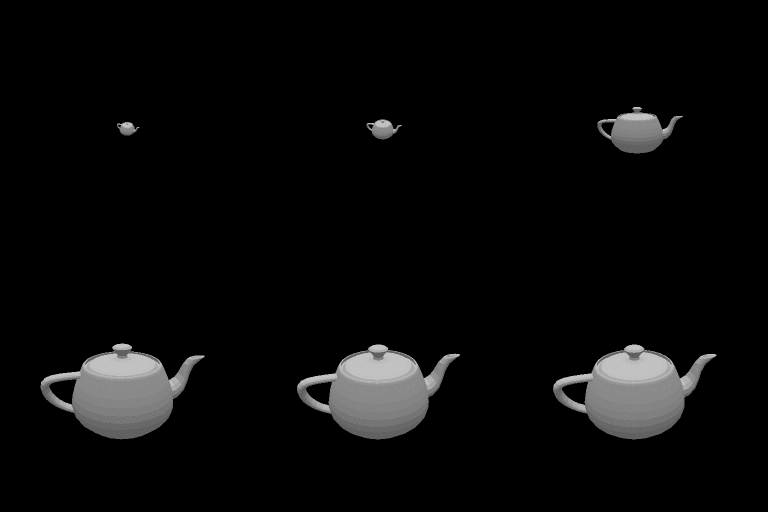
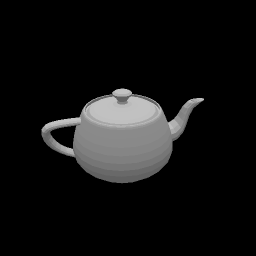
The derivative of images with respect to camera pose can be computed through this renderer. In this example the position of the camera is optimized by gradient descent.

From left to right: reference image, initial state, and optimization process.
Citation

@InProceedings{kato2018renderer
    title={Neural 3D Mesh Renderer},
    author={Kato, Hiroharu and Ushiku, Yoshitaka and Harada, Tatsuya},
    booktitle={The IEEE Conference on Computer Vision and Pattern Recognition (CVPR)},
    year={2018}
}
Owner
Daniilidis Group University of Pennsylvania
Research group of Prof. Kostas Daniilidis
Daniilidis Group University of Pennsylvania
TensorFlow Similarity is a python package focused on making similarity learning quick and easy.

TensorFlow Similarity is a python package focused on making similarity learning quick and easy.

912 Jan 08, 2023
A python script to dump all the challenges locally of a CTFd-based Capture the Flag.

A python script to dump all the challenges locally of a CTFd-based Capture the Flag. Features Connects and logins to a remote CTFd instance. Dumps all

Podalirius 77 Dec 07, 2022
Python implementation of MULTIseq barcode alignment using fuzzy string matching and GMM barcode assignment

Python implementation of MULTIseq barcode alignment using fuzzy string matching and GMM barcode assignment.

MT Schmitz 2 Feb 11, 2022
particle tracking model, works with the ROMS output file(qck.nc, his.nc)

particle-tracking-model-for-ROMS particle tracking model, works with the ROMS output file(qck.nc, his.nc) description this is a 2-dimensional particle

xusheng 1 Jan 11, 2022
Official implementation for "Style Transformer for Image Inversion and Editing" (CVPR 2022)

Style Transformer for Image Inversion and Editing (CVPR2022) https://arxiv.org/abs/2203.07932 Existing GAN inversion methods fail to provide latent co

Xueqi Hu 153 Dec 02, 2022
Logsig-RNN: a novel network for robust and efficient skeleton-based action recognition

GCN_LogsigRNN This repository holds the codebase for the paper: Logsig-RNN: a novel network for robust and efficient skeleton-based action recognition

7 Oct 14, 2022
Neurolab is a simple and powerful Neural Network Library for Python

Neurolab Neurolab is a simple and powerful Neural Network Library for Python. Contains based neural networks, train algorithms and flexible framework

152 Dec 06, 2022
Ranger - a synergistic optimizer using RAdam (Rectified Adam), Gradient Centralization and LookAhead in one codebase

Ranger-Deep-Learning-Optimizer Ranger - a synergistic optimizer combining RAdam (Rectified Adam) and LookAhead, and now GC (gradient centralization) i

Less Wright 1.1k Dec 21, 2022
Code for the bachelors-thesis flaky fault localization

Flaky_Fault_Localization Scripts for the Bachelors-Thesis: "Flaky Fault Localization" by Christian Kasberger. The thesis examines the usefulness of sp

Christian Kasberger 1 Oct 26, 2021
Code Release for ICCV 2021 (oral), "AdaFit: Rethinking Learning-based Normal Estimation on Point Clouds"

AdaFit: Rethinking Learning-based Normal Estimation on Point Clouds (ICCV 2021 oral) **Project Page | Arxiv ** Runsong Zhu¹, Yuan Liu², Zhen Dong¹, Te

40 Dec 30, 2022
a delightful machine learning tool that allows you to train, test and use models without writing code

igel A delightful machine learning tool that allows you to train/fit, test and use models without writing code Note I'm also working on a GUI desktop

Nidhal Baccouri 3k Jan 05, 2023
Deep Reinforcement Learning based Trading Agent for Bitcoin

Deep Trading Agent Deep Reinforcement Learning based Trading Agent for Bitcoin using DeepSense Network for Q function approximation. For complete deta

Kartikay Garg 669 Dec 29, 2022
Content shared at DS-OX Meetup

Streamlit-Projects Streamlit projects available in this repo: An introduction to Streamlit presented at DS-OX (Feb 26, 2020) meetup Streamlit 101 - Ja

Arvindra 69 Dec 23, 2022
Deconfounding Temporal Autoencoder: Estimating Treatment Effects over Time Using Noisy Proxies

Deconfounding Temporal Autoencoder (DTA) This is a repository for the paper "Deconfounding Temporal Autoencoder: Estimating Treatment Effects over Tim

Milan Kuzmanovic 3 Feb 04, 2022
PantheonRL is a package for training and testing multi-agent reinforcement learning environments.

PantheonRL is a package for training and testing multi-agent reinforcement learning environments. PantheonRL supports cross-play, fine-tuning, ad-hoc coordination, and more.

Stanford Intelligent and Interactive Autonomous Systems Group 57 Dec 28, 2022
[ICML'21] Estimate the accuracy of the classifier in various environments through self-supervision

What Does Rotation Prediction Tell Us about Classifier Accuracy under Varying Testing Environments? [Paper] [ICML'21 Project] PyTorch Implementation T

24 Oct 26, 2022
Stacs-ci - A set of modules to enable integration of STACS with commonly used CI / CD systems

Static Token And Credential Scanner CI Integrations What is it? STACS is a YARA

STACS 18 Aug 04, 2022
A repo for Causal Imitation Learning under Temporally Correlated Noise

CausIL A repo for Causal Imitation Learning under Temporally Correlated Noise. Running Experiments To re-train an expert, run: python experts/train_ex

Gokul Swamy 5 Nov 01, 2022
This project provides the proof of the uniqueness of the equilibrium and the global asymptotic stability.

Delayed-cellular-neural-network This project provides the proof of the uniqueness of the equilibrium and the global asymptotic stability. There is als

4 Apr 28, 2022
Official PyTorch implementation of "Uncertainty-Based Offline Reinforcement Learning with Diversified Q-Ensemble" (NeurIPS'21)

Uncertainty-Based Offline Reinforcement Learning with Diversified Q-Ensemble This is the code for reproducing the results of the paper Uncertainty-Bas

43 Nov 23, 2022