Minimal implementation of Denoised Smoothing: A Provable Defense for Pretrained Classifiers in TensorFlow.

Overview

Denoised-Smoothing-TF

Minimal implementation of Denoised Smoothing: A Provable Defense for Pretrained Classifiers in TensorFlow.

Denoised Smoothing is a simple and elegant way to (provably) robustify pre-trained image classification models (including the cloud APIs with only query access) and l2 adversarial attacks. This blog post provides a nice introduction to the method. The figure below summarizes what Denoised Smoothing is and how it works:
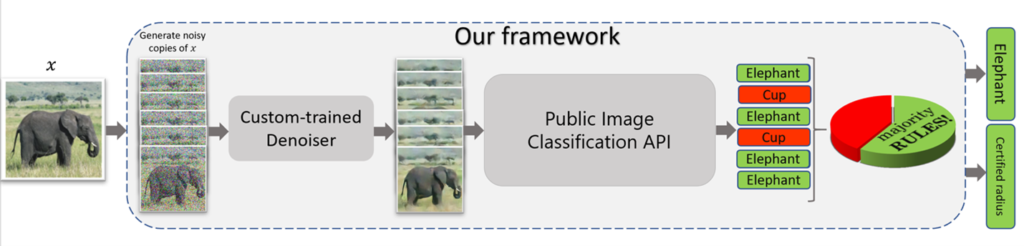

  • Take a pre-trained classifier and prepend a pre-trained denoiser with it. Of course, the dataset on which the classifier and the denoiser would need to be trained on the same/similar dataset.
  • Apply Randomized Smoothing.

Randomized Smoothing is a well-tested method to provably defend against l2 adversarial attacks under a specific radii. But it assumes that a classifier performs well under Gaussian noisy perturbations which may not always be the case.

Note: I utilized many scripts from the official repository of Denoised Smoothing to develop this repository. My aim with this repository is to provide a template for researchers to conduct certification tests with Keras/TensorFlow models. I encourage the readers to check out the original repository, it's really well-developed.

Further notes

All the notebooks can be executed on Colab! You also have the option to train using the free TPUs.

Results

Denoiser with stability objective Denoiser with MSE objective

As we can see prepending a pre-trained denoiser is extremely helpful for our purpose.

Models

The models are available inside models.tar.gz in the SavedModel format. In the interest of reproducibility, the initial model weights are also provided.

Acknowledgements

Paper citation

@inproceedings{NEURIPS2020_f9fd2624,
 author = {Salman, Hadi and Sun, Mingjie and Yang, Greg and Kapoor, Ashish and Kolter, J. Zico},
 booktitle = {Advances in Neural Information Processing Systems},
 editor = {H. Larochelle and M. Ranzato and R. Hadsell and M. F. Balcan and H. Lin},
 pages = {21945--21957},
 publisher = {Curran Associates, Inc.},
 title = {Denoised Smoothing: A Provable Defense for Pretrained Classifiers},
 url = {https://proceedings.neurips.cc/paper/2020/file/f9fd2624beefbc7808e4e405d73f57ab-Paper.pdf},
 volume = {33},
 year = {2020}
}
Owner
Sayak Paul
Trying to learn how machines learn.
Sayak Paul
[ICCV 2021] Released code for Causal Attention for Unbiased Visual Recognition

CaaM This repo contains the codes of training our CaaM on NICO/ImageNet9 dataset. Due to my recent limited bandwidth, this codebase is still messy, wh

Wang Tan 66 Dec 31, 2022
This repository is an open-source implementation of the ICRA 2021 paper: Locus: LiDAR-based Place Recognition using Spatiotemporal Higher-Order Pooling.

Locus This repository is an open-source implementation of the ICRA 2021 paper: Locus: LiDAR-based Place Recognition using Spatiotemporal Higher-Order

Robotics and Autonomous Systems Group 96 Dec 15, 2022
WORD: Revisiting Organs Segmentation in the Whole Abdominal Region

WORD: Revisiting Organs Segmentation in the Whole Abdominal Region (Paper and DataSet). [New] Note that all the emails about the download permission o

Healthcare Intelligence Laboratory 71 Dec 22, 2022
.NET bindings for the Pytorch engine

TorchSharp TorchSharp is a .NET library that provides access to the library that powers PyTorch. It is a work in progress, but already provides a .NET

Matteo Interlandi 17 Aug 30, 2021
This repository contains Prior-RObust Bayesian Optimization (PROBO) as introduced in our paper "Accounting for Gaussian Process Imprecision in Bayesian Optimization"

Prior-RObust Bayesian Optimization (PROBO) Introduction, TOC This repository contains Prior-RObust Bayesian Optimization (PROBO) as introduced in our

Julian Rodemann 2 Mar 19, 2022
Code for EMNLP2020 long paper: BERT-Attack: Adversarial Attack Against BERT Using BERT

BERT-ATTACK Code for our EMNLP2020 long paper: BERT-ATTACK: Adversarial Attack Against BERT Using BERT Dependencies Python 3.7 PyTorch 1.4.0 transform

Linyang Li 142 Jan 04, 2023
RAMA: Rapid algorithm for multicut problem

RAMA: Rapid algorithm for multicut problem Solves multicut (correlation clustering) problems orders of magnitude faster than CPU based solvers without

Paul Swoboda 60 Dec 13, 2022
Machine Learning Model deployment for Container (TensorFlow Serving)

try_tf_serving ├───dataset │ ├───testing │ │ ├───paper │ │ ├───rock │ │ └───scissors │ └───training │ ├───paper │ ├───rock

Azhar Rizki Zulma 5 Jan 07, 2022
Patch-Diffusion Code (AAAI2022)

Patch-Diffusion This is an official PyTorch implementation of "Patch Diffusion: A General Module for Face Manipulation Detection" in AAAI2022. Require

H 7 Nov 02, 2022
C3d-pytorch - Pytorch porting of C3D network, with Sports1M weights

C3D for pytorch This is a pytorch porting of the network presented in the paper Learning Spatiotemporal Features with 3D Convolutional Networks How to

Davide Abati 311 Jan 06, 2023
Codebase for the Summary Loop paper at ACL2020

Summary Loop This repository contains the code for ACL2020 paper: The Summary Loop: Learning to Write Abstractive Summaries Without Examples. Training

Canny Lab @ The University of California, Berkeley 44 Nov 04, 2022
Does Pretraining for Summarization Reuqire Knowledge Transfer?

Pretraining summarization models using a corpus of nonsense

Approximately Correct Machine Intelligence (ACMI) Lab 12 Dec 19, 2022
Creating a Linear Program Solver by Implementing the Simplex Method in Python with NumPy

Creating a Linear Program Solver by Implementing the Simplex Method in Python with NumPy Simplex Algorithm is a popular algorithm for linear programmi

Reda BELHAJ 2 Oct 12, 2022
Unofficial implementation of "Swin Transformer: Hierarchical Vision Transformer using Shifted Windows" (https://arxiv.org/abs/2103.14030)

Swin-Transformer-Tensorflow A direct translation of the official PyTorch implementation of "Swin Transformer: Hierarchical Vision Transformer using Sh

52 Dec 29, 2022
CTRL-C: Camera calibration TRansformer with Line-Classification

CTRL-C: Camera calibration TRansformer with Line-Classification This repository contains the official code and pretrained models for CTRL-C (Camera ca

57 Nov 14, 2022
Implementation of Continuous Sparsification, a method for pruning and ticket search in deep networks

Continuous Sparsification Implementation of Continuous Sparsification (CS), a method based on l_0 regularization to find sparse neural networks, propo

Pedro Savarese 23 Dec 07, 2022
Learning Neural Painters Fast! using PyTorch and Fast.ai

The Joy of Neural Painting Learning Neural Painters Fast! using PyTorch and Fast.ai Blogpost with more details: The Joy of Neural Painting The impleme

Libre AI 72 Nov 10, 2022
A Fast and Stable GAN for Small and High Resolution Imagesets - pytorch

A Fast and Stable GAN for Small and High Resolution Imagesets - pytorch The official pytorch implementation of the paper "Towards Faster and Stabilize

Bingchen Liu 455 Jan 08, 2023
Torch-mutable-modules - Use in-place and assignment operations on PyTorch module parameters with support for autograd

Torch Mutable Modules Use in-place and assignment operations on PyTorch module p

Kento Nishi 7 Jun 06, 2022
Constructing interpretable quadratic accuracy predictors to serve as an objective function for an IQCQP problem that represents NAS under latency constraints and solve it with efficient algorithms.

IQNAS: Interpretable Integer Quadratic programming Neural Architecture Search Realistic use of neural networks often requires adhering to multiple con

0 Oct 24, 2021