

Portfolio analytics for quants, written in Python

Overview
Python version PyPi version PyPi status Travis-CI build status PyPi downloads CodeFactor Star this repo Follow me on twitter

QuantStats: Portfolio analytics for quants

QuantStats Python library that performs portfolio profiling, allowing quants and portfolio managers to understand their performance better by providing them with in-depth analytics and risk metrics.

Changelog »

QuantStats is comprised of 3 main modules:

  1. quantstats.stats - for calculating various performance metrics, like Sharpe ratio, Win rate, Volatility, etc.
  2. quantstats.plots - for visualizing performance, drawdowns, rolling statistics, monthly returns, etc.
  3. quantstats.reports - for generating metrics reports, batch plotting, and creating tear sheets that can be saved as an HTML file.

Here's an example of a simple tear sheet analyzing a strategy:

Quick Start

%matplotlib inline
import quantstats as qs

# extend pandas functionality with metrics, etc.
qs.extend_pandas()

# fetch the daily returns for a stock
stock = qs.utils.download_returns('FB')

# show sharpe ratio
qs.stats.sharpe(stock)

# or using extend_pandas() :)
stock.sharpe()

Output:

0.8135304438803402

Visualize stock performance

qs.plots.snapshot(stock, title='Facebook Performance')

# can also be called via:
# stock.plot_snapshot(title='Facebook Performance')

Output:

Snapshot plot

Creating a report

You can create 7 different report tearsheets:

  1. qs.reports.metrics(mode='basic|full", ...) - shows basic/full metrics
  2. qs.reports.plots(mode='basic|full", ...) - shows basic/full plots
  3. qs.reports.basic(...) - shows basic metrics and plots
  4. qs.reports.full(...) - shows full metrics and plots
  5. qs.reports.html(...) - generates a complete report as html

Let' create an html tearsheet

(benchmark can be a pandas Series or ticker)
qs.reports.html(stock, "SPY")

Output will generate something like this:
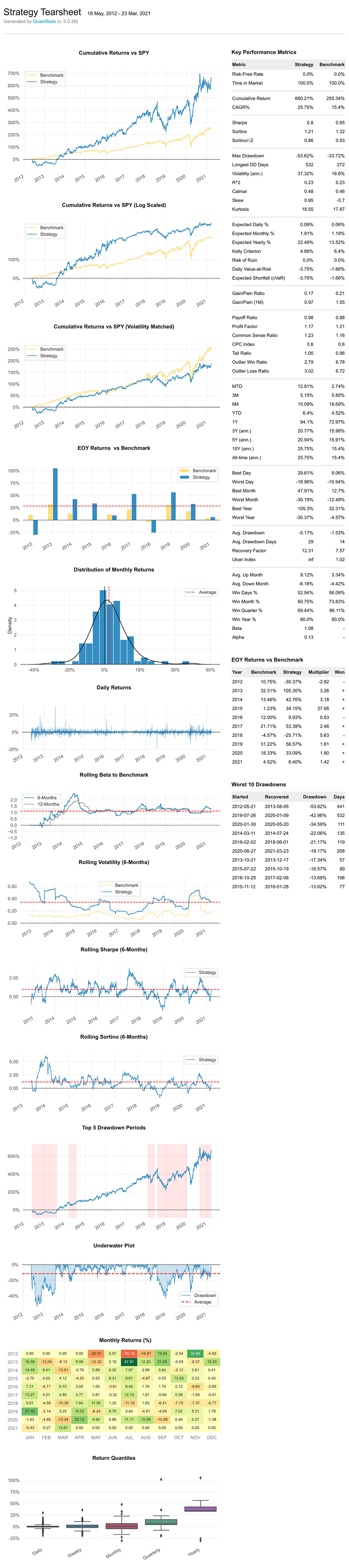
HTML tearsheet

(view original html file)

To view a complete list of available methods, run

[f for f in dir(qs.stats) if f[0] != '_']
['avg_loss',
 'avg_return',
 'avg_win',
 'best',
 'cagr',
 'calmar',
 'common_sense_ratio',
 'comp',
 'compare',
 'compsum',
 'conditional_value_at_risk',
 'consecutive_losses',
 'consecutive_wins',
 'cpc_index',
 'cvar',
 'drawdown_details',
 'expected_return',
 'expected_shortfall',
 'exposure',
 'gain_to_pain_ratio',
 'geometric_mean',
 'ghpr',
 'greeks',
 'implied_volatility',
 'information_ratio',
 'kelly_criterion',
 'kurtosis',
 'max_drawdown',
 'monthly_returns',
 'outlier_loss_ratio',
 'outlier_win_ratio',
 'outliers',
 'payoff_ratio',
 'profit_factor',
 'profit_ratio',
 'r2',
 'r_squared',
 'rar',
 'recovery_factor',
 'remove_outliers',
 'risk_of_ruin',
 'risk_return_ratio',
 'rolling_greeks',
 'ror',
 'sharpe',
 'skew',
 'sortino',
 'adjusted_sortino',
 'tail_ratio',
 'to_drawdown_series',
 'ulcer_index',
 'ulcer_performance_index',
 'upi',
 'utils',
 'value_at_risk',
 'var',
 'volatility',
 'win_loss_ratio',
 'win_rate',
 'worst']
[f for f in dir(qs.plots) if f[0] != '_']
['daily_returns',
 'distribution',
 'drawdown',
 'drawdowns_periods',
 'earnings',
 'histogram',
 'log_returns',
 'monthly_heatmap',
 'returns',
 'rolling_beta',
 'rolling_sharpe',
 'rolling_sortino',
 'rolling_volatility',
 'snapshot',
 'yearly_returns']

*** Full documenttion coming soon ***

In the meantime, you can get insights as to optional parameters for each method, by using Python's help method:

help(qs.stats.conditional_value_at_risk)
Help on function conditional_value_at_risk in module quantstats.stats:

conditional_value_at_risk(returns, sigma=1, confidence=0.99)
    calculats the conditional daily value-at-risk (aka expected shortfall)
    quantifies the amount of tail risk an investment

Installation

Install using pip:

$ pip install quantstats --upgrade --no-cache-dir

Install using conda:

$ conda install -c ranaroussi quantstats

Requirements

Questions?

This is a new library... If you find a bug, please open an issue in this repository.

If you'd like to contribute, a great place to look is the issues marked with help-wanted.

Known Issues

For some reason, I couldn't find a way to tell seaborn not to return the monthly returns heatmap when instructed to save - so even if you save the plot (by passing savefig={...}) it will still show the plot.

Legal Stuff

QuantStats is distributed under the Apache Software License. See the LICENSE.txt file in the release for details.

P.S.

Please drop me a note with any feedback you have.

Ran Aroussi

Comments
  • OverflowError: cannot convert float infinity to integer

    OverflowError: cannot convert float infinity to integer

    test.xlsx Below two functions are not working in attached data.

    1. qs.plots.snapshot()
    2. qs.reports.full()

    Function returns: OverflowError: cannot convert float infinity to integer

    opened by aa-gamJain 22
  • qs.reports.html(), ValueError: cannot convert float NaN to integer

    qs.reports.html(), ValueError: cannot convert float NaN to integer

    Hi, I'm experiencing problems simply using the example from the README to make a report, ie.:

    %matplotlib inline
    import quantstats as qs
    
    # extend pandas functionality with metrics, etc.
    qs.extend_pandas()
    
    # fetch the daily returns for a stock
    stock = qs.utils.download_returns('FB')
    
    qs.reports.html(stock, "SPY)
    

    This results in

    ---------------------------------------------------------------------------
    ValueError                                Traceback (most recent call last)
    <ipython-input-112-5ce6901da6d9> in <module>
    ----> 1 qs.reports.html(stock, benchmark)
    
    ~/WORKSPACE/venv/lib/python3.8/site-packages/quantstats/reports.py in html(returns, benchmark, rf, grayscale, title, output, compounded)
         56     tpl = tpl.replace('{{v}}', __version__)
         57 
    ---> 58     mtrx = metrics(returns=returns, benchmark=benchmark,
         59                    rf=rf, display=False, mode='full',
         60                    sep=True, internal="True",
    
    ~/WORKSPACE/venv/lib/python3.8/site-packages/quantstats/reports.py in metrics(returns, benchmark, rf, display, mode, sep, compounded, **kwargs)
        297 
        298     # return df
    --> 299     dd = _calc_dd(df, display=(display or "internal" in kwargs))
        300 
        301     metrics = _pd.DataFrame()
    
    ~/WORKSPACE/venv/lib/python3.8/site-packages/quantstats/reports.py in _calc_dd(df, display)
        573                 by='max drawdown', ascending=True
        574             )['max drawdown'].values[0] / pct,
    --> 575             'Longest DD Days': str(round(ret_dd.sort_values(
        576                 by='days', ascending=False)['days'].values[0])),
        577             'Avg. Drawdown %': ret_dd['max drawdown'].mean() / pct,
    
    ValueError: cannot convert float NaN to integer
    

    Any help would be much appreciated.

    opened by nistrup 17
  • Rolling beta does not works on small dataframes (`ValueError: cannot convert float NaN to integer`)

    Rolling beta does not works on small dataframes (`ValueError: cannot convert float NaN to integer`)

    The 6 months rolling do not work when there is not enough data.

    Here is the stack trace it generate:

    ...
      File "C:\Users\cacer\Desktop\datacrunch-trading-cli\backtest\export\quants.py", line 84, in finalize
        quantstats.reports.html(merged.daily_profit_pct, merged.close, output=True, download_filename=self.html_output_file)
      File "C:\Users\cacer\AppData\Local\Programs\Python\Python39\lib\site-packages\quantstats\reports.py", line 192, in html
        _plots.rolling_beta(returns, benchmark, grayscale=grayscale,
      File "C:\Users\cacer\AppData\Local\Programs\Python\Python39\lib\site-packages\quantstats\_plotting\wrappers.py", line 514, in rolling_beta
        fig = _core.plot_rolling_beta(returns, benchmark,
      File "C:\Users\cacer\AppData\Local\Programs\Python\Python39\lib\site-packages\quantstats\_plotting\core.py", line 515, in plot_rolling_beta
        mmin = min([-100, int(beta.min()*100)])
    ValueError: cannot convert float NaN to integer
    

    A simple fix can be to do fillna() on the beta after this line: https://github.com/ranaroussi/quantstats/blob/bfc247071fa1b80772cb101f2b31b72b8227cabf/quantstats/_plotting/core.py#L506

    I can do a pull request if you want. Please tell me if you found anything that would make this fix incorrect.

    opened by Caceresenzo 10
  • qs.reports.plots(mode=

    qs.reports.plots(mode="full", ...) returns "AttributeError: 'Int64Index' object has no attribute 'date'" or "TypeError: 'method' object is not subscriptable"

    Hi there,

    Running the simple code below:

    import quantstats as qs
    
    # fetch the daily returns for a stock
    stock = qs.utils.download_returns('FB')
    
    qs.reports.plots(mode="full",returns=stock)
    

    returns the following error:

      File "C:\Users\rapha\OneDrive\Dokumente\GitHub\algorithms\ml4t\tmp.py", line 16, in <module>
        qs.reports.plots(mode="full",returns=stock)
    
      File "C:\Users\rapha\anaconda3\envs\py36-backtrader\lib\site-packages\quantstats\reports.py", line 520, in plots
        show=True, ylabel=False)
    
      File "C:\Users\rapha\anaconda3\envs\py36-backtrader\lib\site-packages\quantstats\_plotting\wrappers.py", line 381, in yearly_returns
        savefig=savefig, show=show)
    
      File "C:\Users\rapha\anaconda3\envs\py36-backtrader\lib\site-packages\quantstats\_plotting\core.py", line 111, in plot_returns_bars
        df.index.date[:1][0].strftime('%Y'),
    
    AttributeError: 'Int64Index' object has no attribute 'date'
    

    If I extend pandas functionnality as suggest in the Quick Start example (qs.extend_pandas), I get a different error at the same place in the code:

      File "C:\Users\rapha\OneDrive\Dokumente\GitHub\algorithms\ml4t\tmp.py", line 16, in <module>
        qs.reports.plots(mode="full",returns=stock)
    
      File "C:\Users\rapha\anaconda3\envs\py36-backtrader\lib\site-packages\quantstats\reports.py", line 520, in plots
        show=True, ylabel=False)
    
      File "C:\Users\rapha\anaconda3\envs\py36-backtrader\lib\site-packages\quantstats\_plotting\wrappers.py", line 381, in yearly_returns
        savefig=savefig, show=show)
    
      File "C:\Users\rapha\anaconda3\envs\py36-backtrader\lib\site-packages\quantstats\_plotting\core.py", line 111, in plot_returns_bars
        df.index.date[:1][0].strftime('%Y'),
    
    AttributeError: 'Int64Index' object has no attribute 'date'
    

    Any idea what the issue is? My environment seems to fit the requirements:

    • Python = 3.6.12
    • pandas = 1.1.3
    • numpy = 1.19.2
    • scipy = 1.5.2
    • matplotlib = 3.2.2
    • seaborn = 0.11.1
    • tabulate = 0.8.7
    • yfinance = 0.1.55
    • plotly = 4.14.3

    Best, Raphaël

    opened by rcardinaux 7
  • calculation issues with rolling_sharpe() and rolling_sortino()

    calculation issues with rolling_sharpe() and rolling_sortino()

    I noticed a couple of calculation issues with the rolling_sharpe() and rolling_sortino() functions used in the tearsheet graphs:

    1. In both rolling_sharpe() and rolling_sortino(): The period variable is used to specify the number of days in the rolling window (by default 126). However, period is also used to annualize the daily returns data for returns and benchmarks, which is incorrect. Irrespective of the number of days in the rolling window, the returns are still daily returns, so the factor should be 252. [For #74, a new variable would need to be created -- period can't do double duty as both the number of datapoints in the rolling window, AND the timespan that each datapoint represents :-) ]
    2. In rolling_sortino() in wrappers.py, the target downside deviation is not calculated as per the Red Rock Capital whitepaper cited in the sortino() function in stats.py. rolling_sortino() throws away all the positive returns and only takes the standard deviation of the negative returns, which is the opposite of the whitepaper's recommendation. I'm currently using this in rolling_sortino() as a workaround:
      from empyrical import roll_sortino_ratio
      returns = roll_sortino_ratio(returns, period)
      

    I'd be happy to provide a pull request for these items, just let me know.

    opened by kartiksubbarao 6
  • when rf is not equal to zero, metric report doesn't look correct.

    when rf is not equal to zero, metric report doesn't look correct.

    qs.reports.full(stock,benchmark='^NSEI',rf=0.065)

    Performance Metrics Strategy Benchmark


    Start Period 2014-11-14 2014-11-14 End Period 2019-11-14 2019-11-14 Risk-Free Rate 0.06% 0.06% Time in Market 100.0% 100.0%

    Cumulative Return -100.0% -100.0% CAGR% -100.0% -100.0% Sharpe -62.45 -118.52 Sortino -15.39 -15.73

    opened by sabirjana 6
  • Feat: Add make_index() for easy index creation

    Feat: Add make_index() for easy index creation

    Easily build an index for a given dictionary of weights and lookback period.

    Example

    FAANG = qs.utils.make_index(
        {
            'FB': 0.2,
            'AAPL': 0.2,
            'AMZN': 0.2,
            'NFLX': 0.2,
            'GOOG': 0.2
        },
    )
    
    qs.plots.snapshot(FAANG.dropna(), "SPY")
    

    Output: image

    opened by ctjlewis 5
  • No output for html reports

    No output for html reports

    Hi team, I have tried to run reports functions on jupyter notebook. However, there's no outpute for qs.reports.html(stock, "SPY"), could any one advise what's missing? Thanks `

    • qs.reports.metrics(mode='basic|full", ...) - shows basic/full metrics
    • qs.reports.plots(mode='basic|full", ...) - shows basic/full plots
    • qs.reports.basic(...) - shows basic metrics and plots
    • qs.reports.full(...) - shows full metrics and plots
    • qs.reports.html(...) - generates a complete report as html`
    opened by boyac 5
  • Profit factor calculation

    Profit factor calculation

    Is there any reason why you calculate profit factor as

    return abs(returns.sum() / returns[returns < 0].sum())
    

    as opposed to:

    return abs(returns[returns > 0].sum() / returns[returns < 0].sum())
    

    I thought normally profit factor is total profit / total loss

    opened by RatkoJ 5
  • Errors when there are no drawdowns

    Errors when there are no drawdowns

    Hello,

    First of all, thank you very much for releasing this lib publicly. I've been using it since it's so much simpler to use than many other ones.

    I did come across a problem when there aren't any drawdowns or if there are fewer than 5 drawdowns. The problem is in at least two places that I've seen.

    In stats._drawdown_details(drawdown), when returning None here, some code later expects a DataFrame and therefore it fails.

    # no drawdown :)
    if len(starts) == 0:
        return None
    

    Even if above we return an empty DataFrame with the right column names, the code that uses this function still fails because range(1,6) is assigned to an index: E.g. in reports.full()

    dd_info = _stats.drawdown_details(dd).sort_values(
            by='max drawdown', ascending=True)[:5]
    dd_info.index = range(1, 6)   # <-- Fails here
    
    opened by RatkoJ 5
  • Added Serenity Index and modified UPI calc

    Added Serenity Index and modified UPI calc

    Hi I've added to the metrics the Serenity index from this papar: https://www.keyquant.com/Download/GetFile?Filename=%5CPublications%5CKeyQuant_WhitePaper_APT_Part1.pdf also in attachment. KeyQuant_WhitePaper_APT_Part1.pdf

    I've also modified the UPI calculation, invoking the ulcer index function, removing copied code and calculating the drawdown on prices and not on daily returns

    Ciao, Giuseppe

    opened by galarosa 3
  • quantstats.reports.full is breaking

    quantstats.reports.full is breaking

    import quantstats quantstats.reports.full(navData, benchmark= indexData)# both have NAV data respectively for Strategy and Index

    Versions: quantstats- '0.0.59' matplotlib- '3.6.2' Python- '3.9'

    ValueError Traceback (most recent call last) ~\AppData\Local\Temp\ipykernel_13940\3446853376.py in ----> 1 quantstats.reports.full(navData, benchmark= indexData)

    ~\AppData\Roaming\Python\Python39\site-packages\quantstats\reports.py in full(returns, benchmark, rf, grayscale, figsize, display, compounded, periods_per_year, match_dates) 314 print('\n\n') 315 print('[Strategy Visualization]\nvia Matplotlib') --> 316 plots(returns=returns, benchmark=benchmark, 317 grayscale=grayscale, figsize=figsize, mode='full', 318 periods_per_year=periods_per_year, prepare_returns=False)

    ~\AppData\Roaming\Python\Python39\site-packages\quantstats\reports.py in plots(returns, benchmark, grayscale, figsize, mode, compounded, periods_per_year, prepare_returns, match_dates) 680 show=True, ylabel=False, 681 prepare_returns=False) --> 682 _plots.yearly_returns(returns, benchmark, 683 grayscale=grayscale, 684 figsize=(figsize[0], figsize[0]*.5),

    ~\AppData\Roaming\Python\Python39\site-packages\quantstats_plotting\wrappers.py in yearly_returns(returns, benchmark, fontname, grayscale, hlw, hlcolor, hllabel, match_volatility, log_scale, figsize, ylabel, subtitle, compounded, savefig, show, prepare_returns) 386 returns = returns.resample('A').last() 387 --> 388 fig = _core.plot_returns_bars(returns, benchmark, 389 fontname=fontname, 390 hline=returns.mean(),

    ~\AppData\Roaming\Python\Python39\site-packages\quantstats_plotting\core.py in plot_returns_bars(returns, benchmark, returns_label, hline, hlw, hlcolor, hllabel, resample, title, match_volatility, log_scale, figsize, grayscale, fontname, ylabel, subtitle, savefig, show) 84 # --------------- 85 colors, _, _ = _get_colors(grayscale) ---> 86 df = _pd.DataFrame(index=returns.index, data={returns_label: returns}) 87 if isinstance(benchmark, _pd.Series): 88 df['Benchmark'] = benchmark[benchmark.index.isin(returns.index)]

    C:\ProgramData\Anaconda3\lib\site-packages\pandas\core\frame.py in init(self, data, index, columns, dtype, copy) 634 elif isinstance(data, dict): 635 # GH#38939 de facto copy defaults to False only in non-dict cases --> 636 mgr = dict_to_mgr(data, index, columns, dtype=dtype, copy=copy, typ=manager) 637 elif isinstance(data, ma.MaskedArray): 638 import numpy.ma.mrecords as mrecords

    C:\ProgramData\Anaconda3\lib\site-packages\pandas\core\internals\construction.py in dict_to_mgr(data, index, columns, dtype, typ, copy) 500 # TODO: can we get rid of the dt64tz special case above? 501 --> 502 return arrays_to_mgr(arrays, columns, index, dtype=dtype, typ=typ, consolidate=copy) 503 504

    C:\ProgramData\Anaconda3\lib\site-packages\pandas\core\internals\construction.py in arrays_to_mgr(arrays, columns, index, dtype, verify_integrity, typ, consolidate) 123 124 # don't force copy because getting jammed in an ndarray anyway --> 125 arrays = _homogenize(arrays, index, dtype) 126 # _homogenize ensures 127 # - all(len(x) == len(index) for x in arrays)

    C:\ProgramData\Anaconda3\lib\site-packages\pandas\core\internals\construction.py in _homogenize(data, index, dtype) 623 val = lib.fast_multiget(val, oindex._values, default=np.nan) 624 --> 625 val = sanitize_array( 626 val, index, dtype=dtype, copy=False, raise_cast_failure=False 627 )

    C:\ProgramData\Anaconda3\lib\site-packages\pandas\core\construction.py in sanitize_array(data, index, dtype, copy, raise_cast_failure, allow_2d) 599 subarr = maybe_infer_to_datetimelike(subarr) 600 --> 601 subarr = _sanitize_ndim(subarr, data, dtype, index, allow_2d=allow_2d) 602 603 if isinstance(subarr, np.ndarray):

    C:\ProgramData\Anaconda3\lib\site-packages\pandas\core\construction.py in _sanitize_ndim(result, data, dtype, index, allow_2d) 650 if allow_2d: 651 return result --> 652 raise ValueError("Data must be 1-dimensional") 653 if is_object_dtype(dtype) and isinstance(dtype, ExtensionDtype): 654 # i.e. PandasDtype("O")

    ValueError: Data must be 1-dimensional

    opened by Virenk 0
  • download returns with period not max

    download returns with period not max

    I have a problem using the download.returns function with the non default option for the period argument.

    It is also not very clear from the code what the period argument is supposed to do. I take it that is there to start collecting data after the specified date.

    For example, I doing this and I get nothing.

    start_date = '2020-11-21'
    qs.utils.download_returns('SPY', period=start_date)
    
    opened by msh855 0
  • ERROR: Data must be 1-dimensional

    ERROR: Data must be 1-dimensional

    I am running quantstats with a custom pandas dataframe of daily returns values from an algo that I am developing. The returns data is formatted like the download from the y-finance with the first column as daily time stamps and the second column with the daily returns. When I run (below) I get the following error.

    qs.reports.full(returns)

    returns is a pandas data frame from June 2022 to end of December 2022.

            Strategy_Returns
    

    time
    2022-06-01 0.000000 2022-06-02 0.000000 2022-06-03 0.000000 2022-06-04 0.000000 2022-06-05 0.000000 ... ... 2022-12-23 0.000000 2022-12-24 0.000000 2022-12-25 -0.000307 2022-12-26 0.015963 2022-12-27 0.004344

    [210 rows x 1 columns]

    Any insights as to what is the underlying cause of the error would be appreciated or does my data set perhaps expose a bug in the library?


    ValueError Traceback (most recent call last) Input In [274], in <cell line: 1>() ----> 1 qs.reports.full(returns)

    File ~/opt/anaconda3/lib/python3.9/site-packages/quantstats/reports.py:317, in full(returns, benchmark, rf, grayscale, figsize, display, compounded, periods_per_year, match_dates) 314 print('\n\n') 315 print('[Strategy Visualization]\nvia Matplotlib') --> 317 plots(returns=returns, benchmark=benchmark, 318 grayscale=grayscale, figsize=figsize, mode='full', 319 periods_per_year=periods_per_year, prepare_returns=False)

    File ~/opt/anaconda3/lib/python3.9/site-packages/quantstats/reports.py:684, in plots(returns, benchmark, grayscale, figsize, mode, compounded, periods_per_year, prepare_returns, match_dates) 677 if benchmark is not None: 678 _plots.returns(returns, benchmark, match_volatility=True, 679 grayscale=grayscale, 680 figsize=(figsize[0], figsize[0].5), 681 show=True, ylabel=False, 682 prepare_returns=False) --> 684 _plots.yearly_returns(returns, benchmark, 685 grayscale=grayscale, 686 figsize=(figsize[0], figsize[0].5), 687 show=True, ylabel=False, 688 prepare_returns=False) 690 _plots.histogram(returns, grayscale=grayscale, 691 figsize=(figsize[0], figsize[0].5), 692 show=True, ylabel=False, 693 prepare_returns=False) 695 _plots.daily_returns(returns, grayscale=grayscale, 696 figsize=(figsize[0], figsize[0].3), 697 show=True, ylabel=False, 698 prepare_returns=False)

    File ~/opt/anaconda3/lib/python3.9/site-packages/quantstats/_plotting/wrappers.py:388, in yearly_returns(returns, benchmark, fontname, grayscale, hlw, hlcolor, hllabel, match_volatility, log_scale, figsize, ylabel, subtitle, compounded, savefig, show, prepare_returns) 385 returns = returns.resample('A').apply(_df.sum) 386 returns = returns.resample('A').last() --> 388 fig = _core.plot_returns_bars(returns, benchmark, 389 fontname=fontname, 390 hline=returns.mean(), 391 hlw=hlw, 392 hllabel=hllabel, 393 hlcolor=hlcolor, 394 match_volatility=match_volatility, 395 log_scale=log_scale, 396 resample=None, 397 title=title, 398 figsize=figsize, 399 grayscale=grayscale, 400 ylabel=ylabel, 401 subtitle=subtitle, 402 savefig=savefig, show=show) 403 if not show: 404 return fig

    File ~/opt/anaconda3/lib/python3.9/site-packages/quantstats/_plotting/core.py:86, in plot_returns_bars(returns, benchmark, returns_label, hline, hlw, hlcolor, hllabel, resample, title, match_volatility, log_scale, figsize, grayscale, fontname, ylabel, subtitle, savefig, show) 84 # --------------- 85 colors, _, _ = _get_colors(grayscale) ---> 86 df = _pd.DataFrame(index=returns.index, data={returns_label: returns}) 87 if isinstance(benchmark, _pd.Series): 88 df['Benchmark'] = benchmark[benchmark.index.isin(returns.index)]

    File ~/opt/anaconda3/lib/python3.9/site-packages/pandas/core/frame.py:636, in DataFrame.init(self, data, index, columns, dtype, copy) 630 mgr = self._init_mgr( 631 data, axes={"index": index, "columns": columns}, dtype=dtype, copy=copy 632 ) 634 elif isinstance(data, dict): 635 # GH#38939 de facto copy defaults to False only in non-dict cases --> 636 mgr = dict_to_mgr(data, index, columns, dtype=dtype, copy=copy, typ=manager) 637 elif isinstance(data, ma.MaskedArray): 638 import numpy.ma.mrecords as mrecords

    File ~/opt/anaconda3/lib/python3.9/site-packages/pandas/core/internals/construction.py:502, in dict_to_mgr(data, index, columns, dtype, typ, copy) 494 arrays = [ 495 x 496 if not hasattr(x, "dtype") or not isinstance(x.dtype, ExtensionDtype) 497 else x.copy() 498 for x in arrays 499 ] 500 # TODO: can we get rid of the dt64tz special case above? --> 502 return arrays_to_mgr(arrays, columns, index, dtype=dtype, typ=typ, consolidate=copy)

    File ~/opt/anaconda3/lib/python3.9/site-packages/pandas/core/internals/construction.py:125, in arrays_to_mgr(arrays, columns, index, dtype, verify_integrity, typ, consolidate) 122 index = ensure_index(index) 124 # don't force copy because getting jammed in an ndarray anyway --> 125 arrays = _homogenize(arrays, index, dtype) 126 # _homogenize ensures 127 # - all(len(x) == len(index) for x in arrays) 128 # - all(x.ndim == 1 for x in arrays) (...) 131 132 else: 133 index = ensure_index(index)

    File ~/opt/anaconda3/lib/python3.9/site-packages/pandas/core/internals/construction.py:625, in _homogenize(data, index, dtype) 622 val = dict(val) 623 val = lib.fast_multiget(val, oindex._values, default=np.nan) --> 625 val = sanitize_array( 626 val, index, dtype=dtype, copy=False, raise_cast_failure=False 627 ) 628 com.require_length_match(val, index) 630 homogenized.append(val)

    File ~/opt/anaconda3/lib/python3.9/site-packages/pandas/core/construction.py:601, in sanitize_array(data, index, dtype, copy, raise_cast_failure, allow_2d) 598 subarr = cast(np.ndarray, subarr) 599 subarr = maybe_infer_to_datetimelike(subarr) --> 601 subarr = _sanitize_ndim(subarr, data, dtype, index, allow_2d=allow_2d) 603 if isinstance(subarr, np.ndarray): 604 # at this point we should have dtype be None or subarr.dtype == dtype 605 dtype = cast(np.dtype, dtype)

    File ~/opt/anaconda3/lib/python3.9/site-packages/pandas/core/construction.py:652, in _sanitize_ndim(result, data, dtype, index, allow_2d) 650 if allow_2d: 651 return result --> 652 raise ValueError("Data must be 1-dimensional") 653 if is_object_dtype(dtype) and isinstance(dtype, ExtensionDtype): 654 # i.e. PandasDtype("O") 656 result = com.asarray_tuplesafe(data, dtype=np.dtype("object"))

    ValueError: Data must be 1-dimensional

    opened by gatorfan1990 0
  • Example doesn't work

    Example doesn't work

    As it said in readme:

    %matplotlib inline import quantstats as qs

    qs.extend_pandas()

    stock = qs.utils.download_returns('FB')

    qs.stats.sharpe(stock)

    stock.sharpe()

    the execution result:

    Got error from yahoo api for ticker FB, Error: {'code': 'Not Found', 'description': 'No data found, symbol may be delisted'}

    • FB: No timezone found, symbol may be delisted nan
    opened by Whisperes 0
  • inconsistent days treatment for returns vs pv

    inconsistent days treatment for returns vs pv

    consider the code similar to #233

    import pandas as pd
    import quantstats as qs
    
    pv_raw = [100, 101, 99, 98, 97, 101, 99]
    dates = pd.date_range("2022-12-01", periods=7)
    pv = pd.DataFrame(pv_raw, index=dates, columns=["pv"])
    vol = qs.stats.volatility(pv)
    sharpe = qs.stats.sharpe(pv)
    
    # calculate daily returns, no first day return as since data is daily (assumed EOD) 
    rt = pv.pct_change()
    rt = rt[1:]
    vol2 = qs.stats.volatility(rt)
    sharpe2 = qs.stats.sharpe(rt)
    

    printouts

    >>> vol[0], vol2[0]
    (0.3417106479175939, 0.3742046996695246)
    >>> sharpe[0], sharpe2[0]
    (-0.9136086220829638, -0.9733213582901914)
    

    volatility, sharpe and almost every other metric differs b/c when calculated from pv quantstats calculates statistics for the one extra first day as well (where returns are NaN). The results differ only a little bit, but it is quite annoying especially when trying to debug and compare results vs external stats valuation

    on the other hand, if correct, trimmed returns (like rt above) are supplied to qs.reports.html(), then plots do not start at 0/100% point, which is also confusing

    opened by drusakov778 0
Releases(0.0.59)
Owner
Ran Aroussi
Founder @Tradologics. Creator of tools for traders. Programming is how I meditate.
Ran Aroussi
Pure python implementations of popular ML algorithms.

Minimal ML algorithms This repo includes minimal implementations of popular ML algorithms using pure python and numpy. The purpose of these notebooks

Alexis Gidiotis 3 Jan 10, 2022
Official PyTorch implementation of "VITON-HD: High-Resolution Virtual Try-On via Misalignment-Aware Normalization" (CVPR 2021)

VITON-HD — Official PyTorch Implementation VITON-HD: High-Resolution Virtual Try-On via Misalignment-Aware Normalization Seunghwan Choi*1, Sunghyun Pa

Seunghwan Choi 250 Jan 06, 2023
People Interaction Graph

Gihan Jayatilaka*, Jameel Hassan*, Suren Sritharan*, Janith Senananayaka, Harshana Weligampola, et. al., 2021. Holistic Interpretation of Public Scenes Using Computer Vision and Temporal Graphs to Id

University of Peradeniya : COVID Research Group 1 Aug 24, 2022
List of all dependencies affected by node-ipc malicious commit

node-ipc-dependencies-list List of all dependencies affected by node-ipc malicious commit as of 17/3/2022 - 19/3/2022 (timestamp) Please improve upon

99 Oct 15, 2022
ElegantRL is featured with lightweight, efficient and stable, for researchers and practitioners.

Lightweight, efficient and stable implementations of deep reinforcement learning algorithms using PyTorch. 🔥

AI4Finance 2.5k Jan 08, 2023
Deeply Supervised, Layer-wise Prediction-aware (DSLP) Transformer for Non-autoregressive Neural Machine Translation

Non-Autoregressive Translation with Layer-Wise Prediction and Deep Supervision Training Efficiency We show the training efficiency of our DSLP model b

Chenyang Huang 36 Oct 31, 2022
Federated Deep Reinforcement Learning for the Distributed Control of NextG Wireless Networks.

FDRL-PC-Dyspan Federated Deep Reinforcement Learning for the Distributed Control of NextG Wireless Networks. This repository contains the entire code

Peyman Tehrani 17 Nov 18, 2022
PyTorch implementation of DARDet: A Dense Anchor-free Rotated Object Detector in Aerial Images

DARDet PyTorch implementation of "DARDet: A Dense Anchor-free Rotated Object Detector in Aerial Images", [pdf]. Highlights: 1. We develop a new dense

41 Oct 23, 2022
Implementation of CVPR 2020 Dual Super-Resolution Learning for Semantic Segmentation

Dual super-resolution learning for semantic segmentation 2021-01-02 Subpixel Update Happy new year! The 2020-12-29 update of SISR with subpixel conv p

Sam 79 Nov 24, 2022
PyTorch framework, for reproducing experiments from the paper Implicit Regularization in Hierarchical Tensor Factorization and Deep Convolutional Neural Networks

Implicit Regularization in Hierarchical Tensor Factorization and Deep Convolutional Neural Networks. Code, based on the PyTorch framework, for reprodu

Asaf 3 Dec 27, 2022
Keyword2Text This repository contains the code of the paper: "A Plug-and-Play Method for Controlled Text Generation"

Keyword2Text This repository contains the code of the paper: "A Plug-and-Play Method for Controlled Text Generation", if you find this useful and use

57 Dec 27, 2022
Image morphing without reference points by applying warp maps and optimizing over them.

Differentiable Morphing Image morphing without reference points by applying warp maps and optimizing over them. Differentiable Morphing is machine lea

Alex K 380 Dec 19, 2022
Mae segmentation - Reproduction of semantic segmentation using masked autoencoder (mae)

ADE20k Semantic segmentation with MAE Getting started Install the mmsegmentation

97 Dec 17, 2022
LineBoard - Python+React+MySQL-白板即時系統改善人群行為

LineBoard-白板即時系統改善人群行為 即時顯示實驗室的使用狀況,並遠端預約排隊,以此來改善人們的工作效率 程式架構 運作流程 使用者先至該實驗室網站預約

Bo-Jyun Huang 1 Feb 22, 2022
A synthetic texture-invariant dataset for object detection of UAVs

A synthetic dataset for object detection of UAVs This repository contains a synthetic datasets accompanying the paper Sim2Air - Synthetic aerial datas

LARICS Lab 10 Aug 13, 2022
Image-to-image regression with uncertainty quantification in PyTorch

Image-to-image regression with uncertainty quantification in PyTorch. Take any dataset and train a model to regress images to images with rigorous, distribution-free uncertainty quantification.

Anastasios Angelopoulos 25 Dec 26, 2022
Open CV - Convert a picture to look like a cartoon sketch in python

Use the video https://www.youtube.com/watch?v=k7cVPGpnels for initial learning.

Sammith S Bharadwaj 3 Jan 29, 2022
This repository is for the preprint "A generative nonparametric Bayesian model for whole genomes"

BEAR Overview This repository contains code associated with the preprint A generative nonparametric Bayesian model for whole genomes (2021), which pro

Debora Marks Lab 10 Sep 18, 2022
Methods to get the probability of a changepoint in a time series.

Bayesian Changepoint Detection Methods to get the probability of a changepoint in a time series. Both online and offline methods are available. Read t

Johannes Kulick 554 Dec 30, 2022
Group R-CNN for Point-based Weakly Semi-supervised Object Detection (CVPR2022)

Group R-CNN for Point-based Weakly Semi-supervised Object Detection (CVPR2022) By Shilong Zhang*, Zhuoran Yu*, Liyang Liu*, Xinjiang Wang, Aojun Zhou,

Shilong Zhang 129 Dec 24, 2022