Accelerated NLP pipelines for fast inference on CPU and GPU. Built with Transformers, Optimum and ONNX Runtime.

Overview

Optimum Transformers


Tests License PyPI

Accelerated NLP pipelines for fast inference 🚀 on CPU and GPU. Built with 🤗 Transformers, Optimum and ONNX runtime.

Installation:

With PyPI:

pip install optimum-transformers

Or directly from GitHub:

pip install git+https://github.com/AlekseyKorshuk/optimum-transformers

Usage:

The pipeline API is similar to transformers pipeline with just a few differences which are explained below.

Just provide the path/url to the model, and it'll download the model if needed from the hub and automatically create onnx graph and run inference.

from optimum_transformers import pipeline

# Initialize a pipeline by passing the task name and 
# set onnx to True (default value is also True)
nlp = pipeline("sentiment-analysis", use_onnx=True)
nlp("Transformers and onnx runtime is an awesome combo!")
# [{'label': 'POSITIVE', 'score': 0.999721109867096}]  

Or provide a different model using the model argument.

from optimum_transformers import pipeline

nlp = pipeline("question-answering", model="deepset/roberta-base-squad2", use_onnx=True)
nlp(question="What is ONNX Runtime ?",
         context="ONNX Runtime is a highly performant single inference engine for multiple platforms and hardware")
# {'answer': 'highly performant single inference engine for multiple platforms and hardware', 'end': 94,
# 'score': 0.751201868057251, 'start': 18}
from optimum_transformers import pipeline

nlp = pipeline("ner", model="mys/electra-base-turkish-cased-ner", use_onnx=True, optimize=True,
                    grouped_entities=True)
nlp("adana kebap ülkemizin önemli lezzetlerinden biridir.")
# [{'entity_group': 'B-food', 'score': 0.869149774312973, 'word': 'adana kebap'}]

Set use_onnx to False for standard torch inference. Set optimize to True for quantize with ONNX. ( set use_onnx to True)

Supported pipelines

You can create Pipeline objects for the following down-stream tasks:

  • feature-extraction: Generates a tensor representation for the input sequence
  • ner and token-classification: Generates named entity mapping for each word in the input sequence.
  • sentiment-analysis: Gives the polarity (positive / negative) of the whole input sequence. Can be used for any text classification model.
  • question-answering: Provided some context and a question referring to the context, it will extract the answer to the question in the context.
  • text-classification: Classifies sequences according to a given number of classes from training.
  • zero-shot-classification: Classifies sequences according to a given number of classes directly in runtime.
  • fill-mask: The task of masking tokens in a sequence with a masking token, and prompting the model to fill that mask with an appropriate token.
  • text-generation: The task of generating text according to the previous text provided.

Calling the pipeline for the first time loads the model, creates the onnx graph, and caches it for future use. Due to this, the first load will take some time. Subsequent calls to the same model will load the onnx graph automatically from the cache.

Benchmarks

Note: For some reason, onnx is slow on colab notebook, so you won't notice any speed-up there. Benchmark it on your own hardware.

Check our example of benchmarking: example.

For detailed benchmarks and other information refer to this blog post and notebook.

Note: These results were collected on my local machine. So if you have high performance machine to benchmark, please contact me.

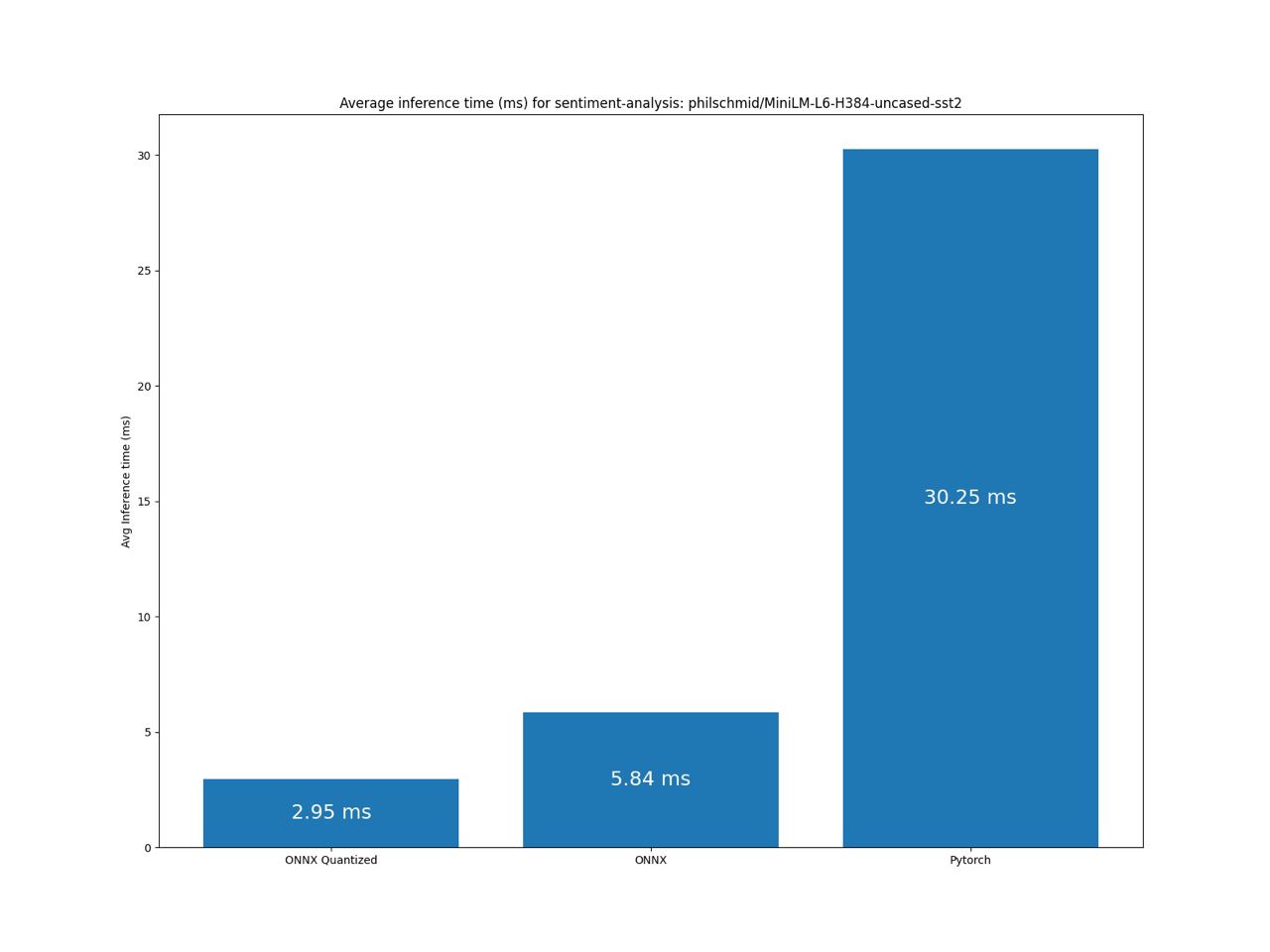
Benchmark sentiment-analysis pipeline
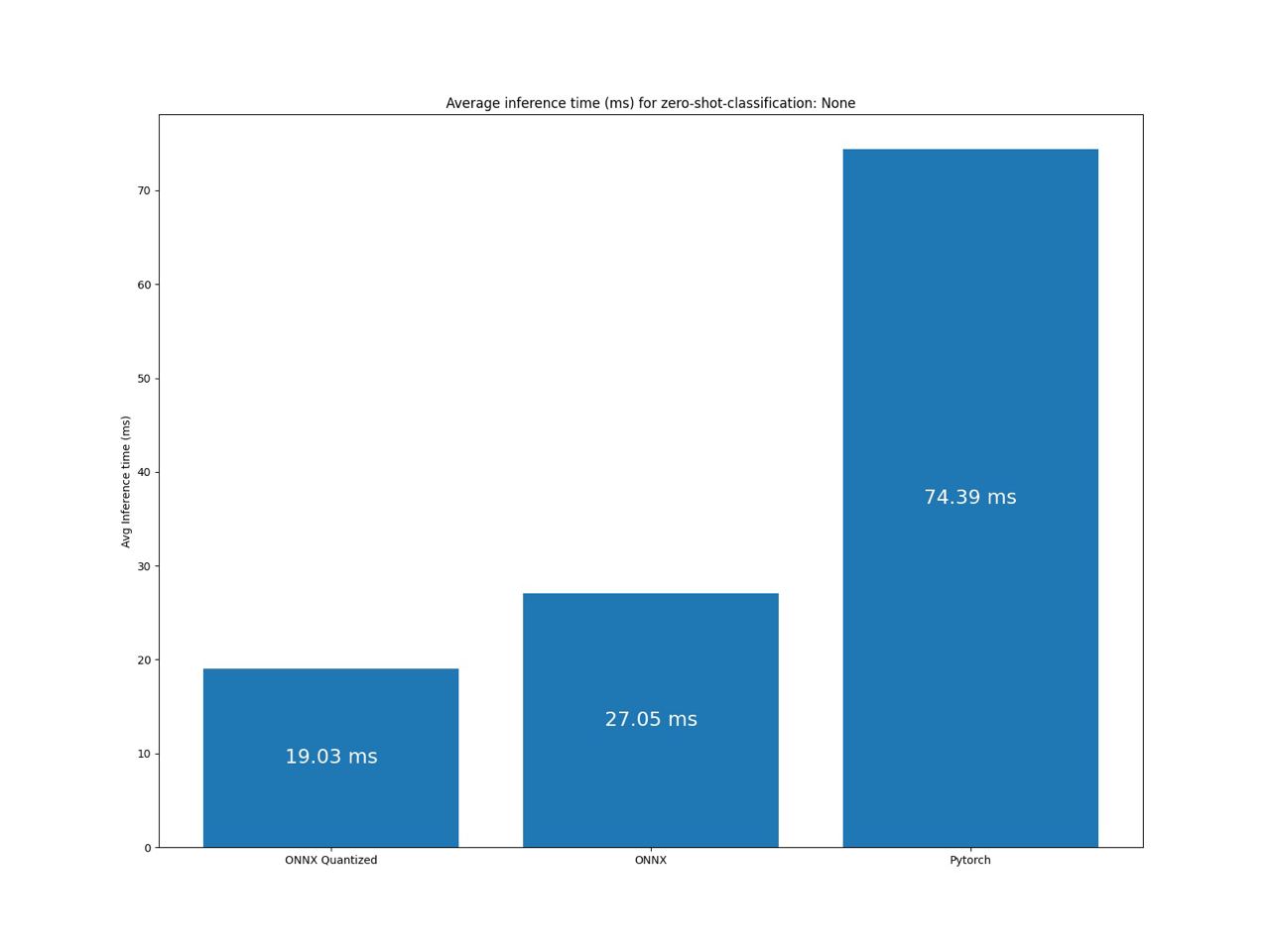
Benchmark zero-shot-classification pipeline
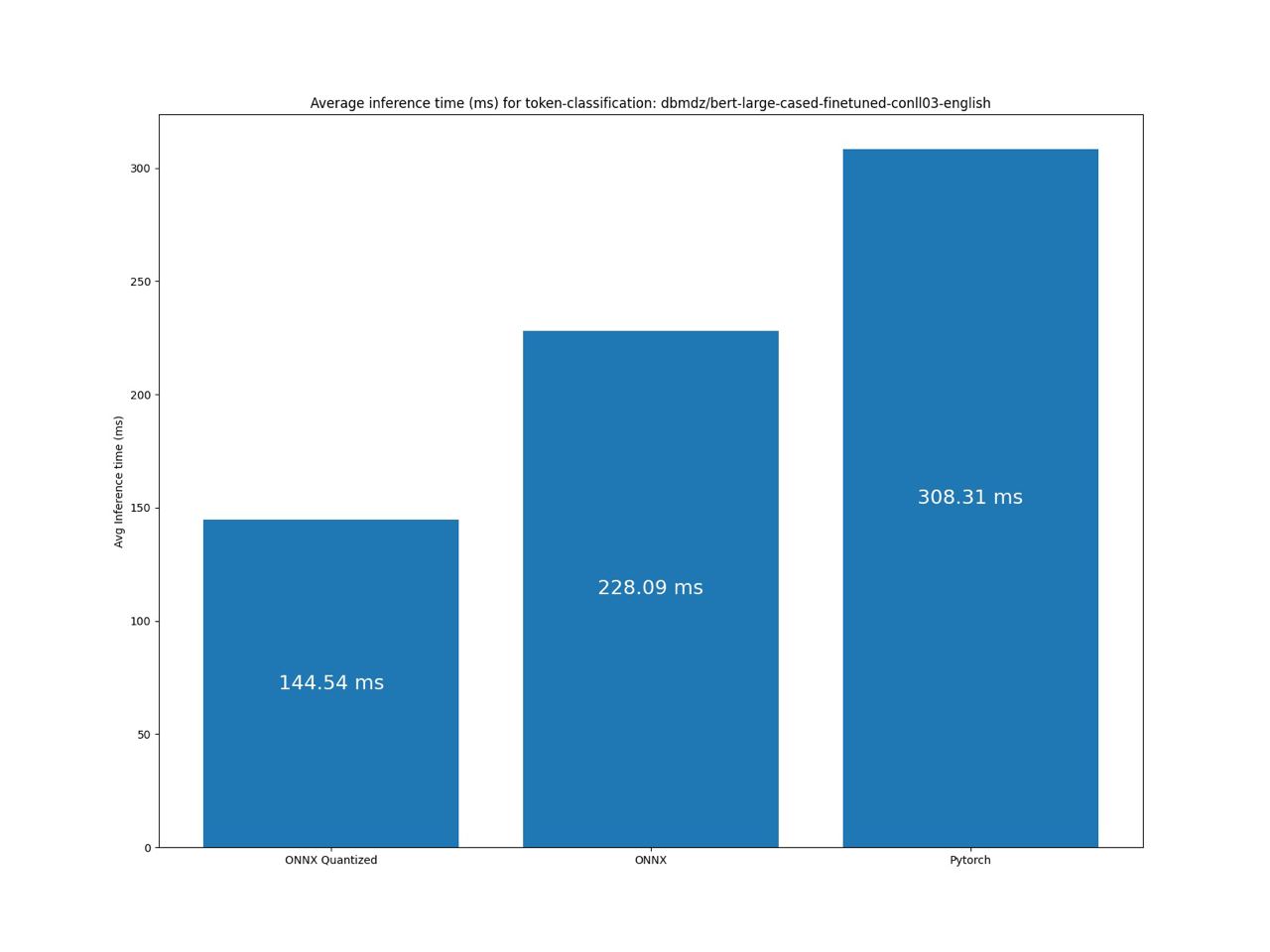
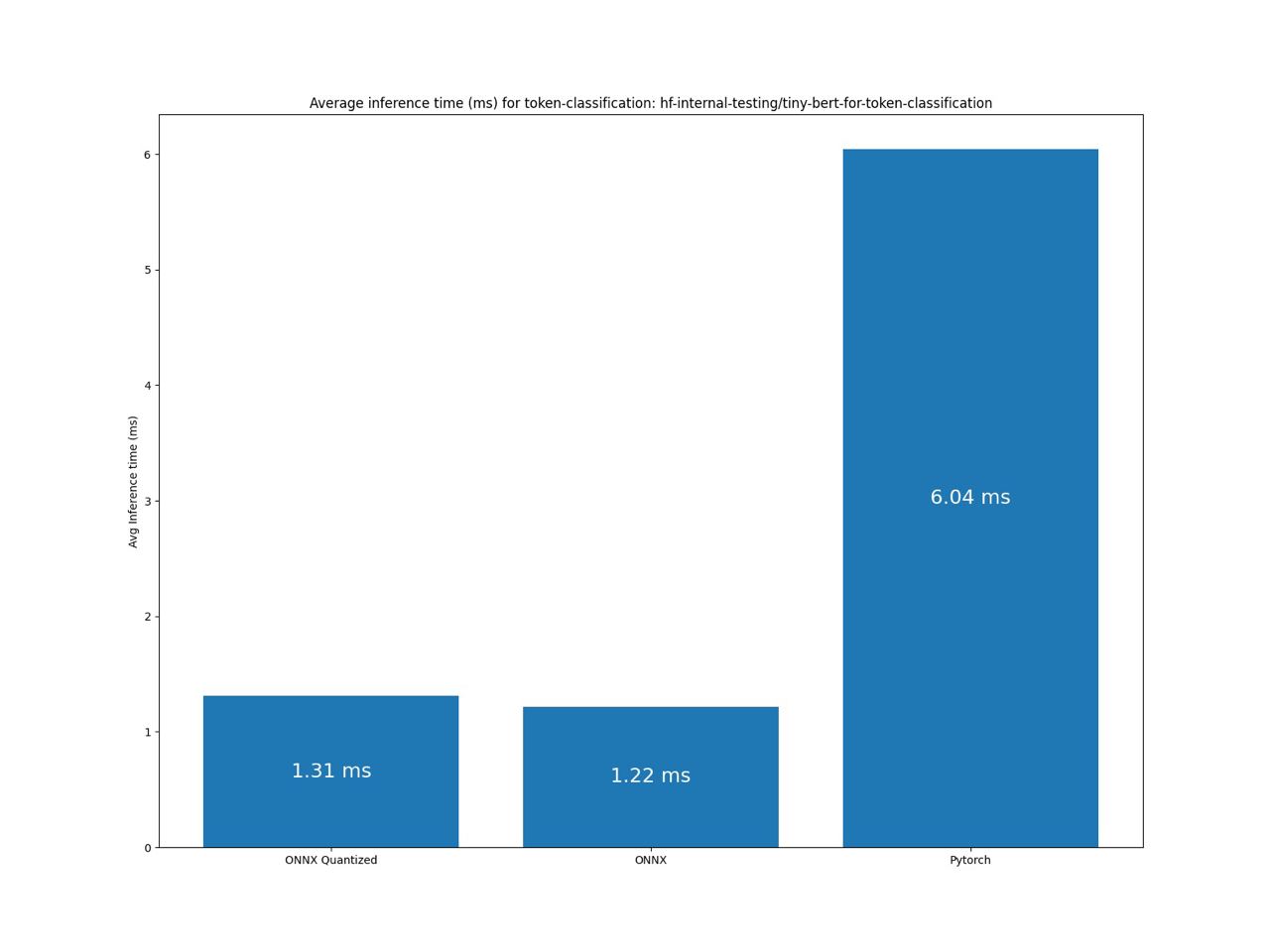
Benchmark token-classification pipeline
Benchmark question-answering pipeline

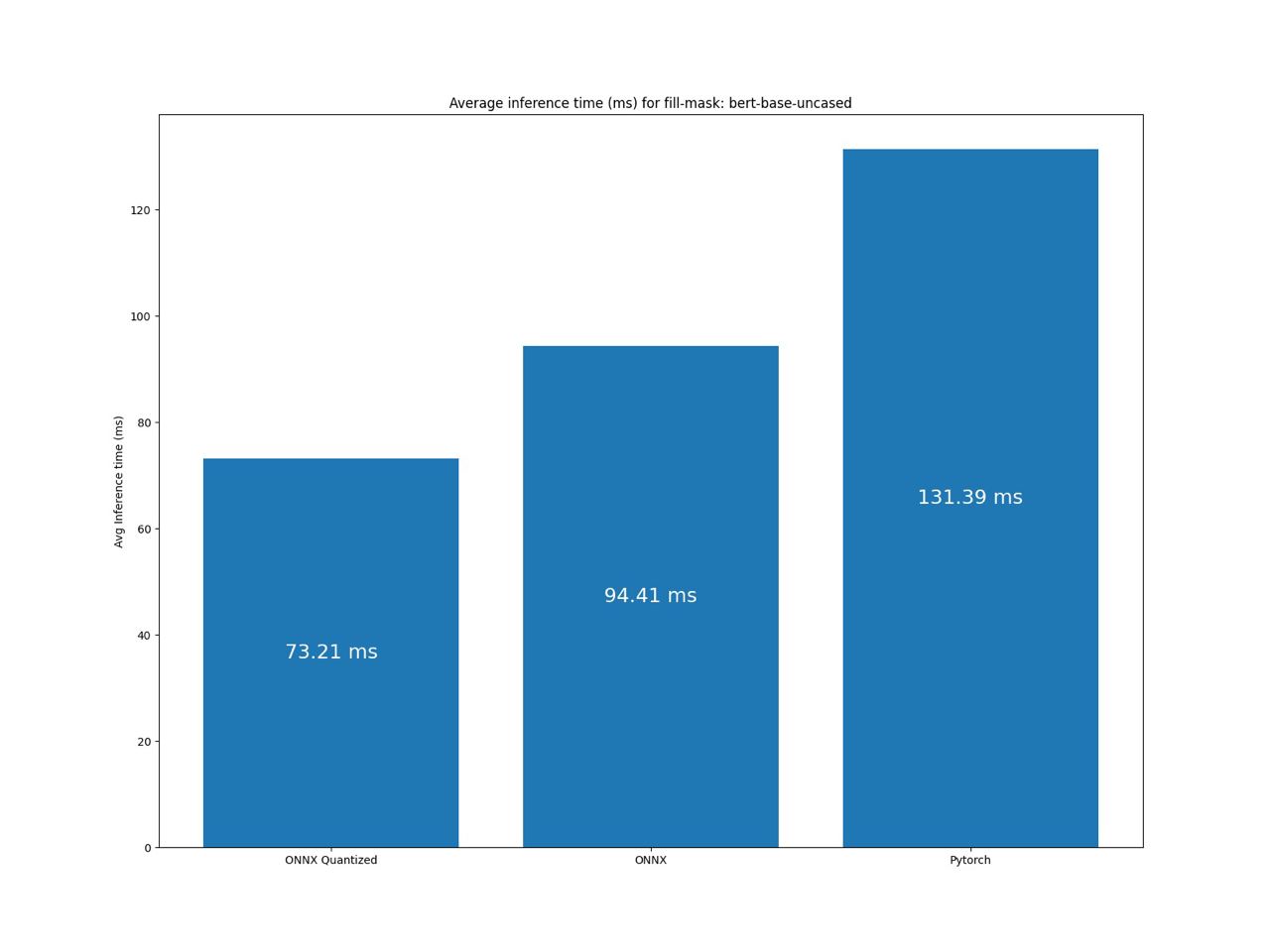
Benchmark fill-mask pipeline
About

Built by Aleksey Korshuk

Follow

Follow

Follow

🚀 If you want to contribute to this project OR create something cool together — contact me: link

Star this repository:

GitHub stars

Resources

You might also like...
ONNX Runtime: cross-platform, high performance ML inferencing and training accelerator

ONNX Runtime is a cross-platform inference and training machine-learning accelerator. ONNX Runtime inference can enable faster customer experiences an

Very simple NCHW and NHWC conversion tool for ONNX. Change to the specified input order for each and every input OP. Also, change the channel order of RGB and BGR. Simple Channel Converter for ONNX.

scc4onnx Very simple NCHW and NHWC conversion tool for ONNX. Change to the specified input order for each and every input OP. Also, change the channel

A very simple tool to rewrite parameters such as attributes and constants for OPs in ONNX models. Simple Attribute and Constant Modifier for ONNX.

sam4onnx A very simple tool to rewrite parameters such as attributes and constants for OPs in ONNX models. Simple Attribute and Constant Modifier for

A repository that shares tuning results of trained models generated by TensorFlow / Keras. Post-training quantization (Weight Quantization, Integer Quantization, Full Integer Quantization, Float16 Quantization), Quantization-aware training. TensorFlow Lite. OpenVINO. CoreML. TensorFlow.js. TF-TRT. MediaPipe. ONNX. [.tflite,.h5,.pb,saved_model,tfjs,tftrt,mlmodel,.xml/.bin, .onnx] ONNX-GLPDepth - Python scripts for performing monocular depth estimation using the GLPDepth model in ONNX
ONNX-GLPDepth - Python scripts for performing monocular depth estimation using the GLPDepth model in ONNX

ONNX-GLPDepth - Python scripts for performing monocular depth estimation using the GLPDepth model in ONNX

ONNX-PackNet-SfM: Python scripts for performing monocular depth estimation using the PackNet-SfM model in ONNX

Python scripts for performing monocular depth estimation using the PackNet-SfM model in ONNX

A very simple tool for situations where optimization with onnx-simplifier would exceed the Protocol Buffers upper file size limit of 2GB, or simply to separate onnx files to any size you want.

sne4onnx A very simple tool for situations where optimization with onnx-simplifier would exceed the Protocol Buffers upper file size limit of 2GB, or

Simple ONNX operation generator. Simple Operation Generator for ONNX.

sog4onnx Simple ONNX operation generator. Simple Operation Generator for ONNX. https://github.com/PINTO0309/simple-onnx-processing-tools Key concept V

Simple tool to combine(merge) onnx models.  Simple Network Combine Tool for ONNX.
Simple tool to combine(merge) onnx models. Simple Network Combine Tool for ONNX.

snc4onnx Simple tool to combine(merge) onnx models. Simple Network Combine Tool for ONNX. https://github.com/PINTO0309/simple-onnx-processing-tools 1.

Releases(v0.2.1-upd)
Owner
Aleksey Korshuk
Aleksey Korshuk
Code, environments, and scripts for the paper: "How Private Is Your RL Policy? An Inverse RL Based Analysis Framework"

Privacy-Aware Inverse RL (PRIL) Analysis Framework Code, environments, and scripts for the paper: "How Private Is Your RL Policy? An Inverse RL Based

1 Dec 06, 2021
PyTorch implementation of DUL (Data Uncertainty Learning in Face Recognition, CVPR2020)

PyTorch implementation of DUL (Data Uncertainty Learning in Face Recognition, CVPR2020)

Mouxiao Huang 20 Nov 15, 2022
Research Artifact of USENIX Security 2022 Paper: Automated Side Channel Analysis of Media Software with Manifold Learning

Automated Side Channel Analysis of Media Software with Manifold Learning Official implementation of USENIX Security 2022 paper: Automated Side Channel

Yuanyuan Yuan 175 Jan 07, 2023
implicit displacement field

Geometry-Consistent Neural Shape Representation with Implicit Displacement Fields [project page][paper][cite] Geometry-Consistent Neural Shape Represe

Yifan Wang 100 Dec 19, 2022
The description of FMFCC-A (audio track of FMFCC) dataset and Challenge resluts.

FMFCC-A This project is the description of FMFCC-A (audio track of FMFCC) dataset and Challenge resluts. The FMFCC-A dataset is shared through BaiduCl

18 Dec 24, 2022
An efficient PyTorch library for Global Wheat Detection using YOLOv5. The project is based on this Kaggle competition Global Wheat Detection (2021).

Global-Wheat-Detection An efficient PyTorch library for Global Wheat Detection using YOLOv5. The project is based on this Kaggle competition Global Wh

Chuxin Wang 11 Sep 25, 2022
Multi-label classification of retinal disorders

Multi-label classification of retinal disorders This is a deep learning course project. The goal is to develop a solution, using computer vision techn

Sundeep Bhimireddy 1 Jan 29, 2022
Code for Understanding Pooling in Graph Neural Networks

Select, Reduce, Connect This repository contains the code used for the experiments of: "Understanding Pooling in Graph Neural Networks" Setup Install

Daniele Grattarola 37 Dec 13, 2022
The 1st place solution of track2 (Vehicle Re-Identification) in the NVIDIA AI City Challenge at CVPR 2021 Workshop.

AICITY2021_Track2_DMT The 1st place solution of track2 (Vehicle Re-Identification) in the NVIDIA AI City Challenge at CVPR 2021 Workshop. Introduction

Hao Luo 91 Dec 21, 2022
Deformable DETR is an efficient and fast-converging end-to-end object detector.

Deformable DETR: Deformable Transformers for End-to-End Object Detection.

2k Jan 05, 2023
Implementation of E(n)-Transformer, which extends the ideas of Welling's E(n)-Equivariant Graph Neural Network to attention

E(n)-Equivariant Transformer (wip) Implementation of E(n)-Equivariant Transformer, which extends the ideas from Welling's E(n)-Equivariant G

Phil Wang 132 Jan 02, 2023
Supplementary code for the AISTATS 2021 paper "Matern Gaussian Processes on Graphs".

Matern Gaussian Processes on Graphs This repo provides an extension for gpflow with Matérn kernels, inducing variables and trainable models implemente

41 Dec 17, 2022
Lab Materials for MIT 6.S191: Introduction to Deep Learning

This repository contains all of the code and software labs for MIT 6.S191: Introduction to Deep Learning! All lecture slides and videos are available

Alexander Amini 5.6k Dec 26, 2022
Official Implementation of 'UPDeT: Universal Multi-agent Reinforcement Learning via Policy Decoupling with Transformers' ICLR 2021(spotlight)

UPDeT Official Implementation of UPDeT: Universal Multi-agent Reinforcement Learning via Policy Decoupling with Transformers (ICLR 2021 spotlight) The

hhhusiyi 96 Dec 22, 2022
Code for our NeurIPS 2021 paper Mining the Benefits of Two-stage and One-stage HOI Detection

CDN Code for our NeurIPS 2021 paper "Mining the Benefits of Two-stage and One-stage HOI Detection". Contributed by Aixi Zhang*, Yue Liao*, Si Liu, Mia

71 Dec 14, 2022
Crossover Learning for Fast Online Video Instance Segmentation (ICCV 2021)

TL;DR: CrossVIS (Crossover Learning for Fast Online Video Instance Segmentation) proposes a novel crossover learning paradigm to fully leverage rich c

Hust Visual Learning Team 79 Nov 25, 2022
An Open-Source Toolkit for Prompt-Learning.

An Open-Source Framework for Prompt-learning. Overview • Installation • How To Use • Docs • Paper • Citation • What's New? Nov 2021: Now we have relea

THUNLP 2.3k Jan 07, 2023
A Peer-to-peer Platform for Secure, Privacy-preserving, Decentralized Data Science

PyGrid is a peer-to-peer network of data owners and data scientists who can collectively train AI models using PySyft. PyGrid is also the central serv

OpenMined 615 Jan 03, 2023
Codebase for "Revisiting spatio-temporal layouts for compositional action recognition" (Oral at BMVC 2021).

Revisiting spatio-temporal layouts for compositional action recognition Codebase for "Revisiting spatio-temporal layouts for compositional action reco

Gorjan 20 Dec 15, 2022
The code for replicating the experiments from the LFI in SSMs with Unknown Dynamics paper.

Likelihood-Free Inference in State-Space Models with Unknown Dynamics This package contains the codes required to run the experiments in the paper. Th

Alex Aushev 0 Dec 27, 2021