ICON: Implicit Clothed humans Obtained from Normals

Related tags

Deep LearningICON
Overview

ICON: Implicit Clothed humans Obtained from Normals

Logo

arXiv, December 2021.
Yuliang Xiu · Jinlong Yang · Dimitrios Tzionas · Michael J. Black

Paper PDF Project Page


Table of Contents
  1. Who needs ICON
  2. More Qualitative Results
  3. Introduction Video
  4. Citation
  5. Acknowledgments
  6. Disclosure
  7. Contact


Who needs ICON?

  • If you want to reconstruct 3D clothed humans in unconstrained poses from in-the-wild images
    • together with the body under clothing (e.g. SMPL, SMPL-X)
    • clothed-body normal maps (front/back) predicted from images
All Intermedia Results
ICON's outputs from single RGB image
  • If you want to obtain a realistic and animatable 3D clothed avatar direclty from video / a sequence of monocular images
    • fully-textured with per-vertex color
    • could be animated by SMPL pose parameters
    • with pose-dependent clothing deformation
ICON+SCANimate+AIST++
3D Clothed Avatar, created from 400+ images using ICON+SCANimate, animated by AIST++


More Qualitative Results

Comparison
Comparison with other state-of-the-art methods
extreme
Reconstruction on in-the-wild photos with extreme poses (GIF)
extreme
Reconstruction on in-the-wild photos with extreme poses (PNG)
extreme
Predicted normals on in-the-wild images with extreme poses


Introduction Video

ICON.mp4


Citation

@misc{xiu2021icon,
      title={ICON: Implicit Clothed humans Obtained from Normals}, 
      author={Yuliang Xiu and Jinlong Yang and Dimitrios Tzionas and Michael J. Black},
      year={2021},
      eprint={2112.09127},
      archivePrefix={arXiv},
      primaryClass={cs.CV}
}

Acknowledgments

We thank Yao Feng, Soubhik Sanyal, Qianli Ma, Hongwei Yi, Chun-Hao Paul Huang, Weiyang Liu, and Xu Chen for their feedback and discussions, Tsvetelina Alexiadis for her help with the AMT perceptual study, Taylor McConnell for her voice over, and Yuanlu Xu's help in comparing with ARCH and ARCH++.

Here are some great resources we benefit from:

Some images used in the qualitative examples come from pinterest.com.

This project has received funding from the European Union’s Horizon 2020 research and innovation programme under the Marie Skłodowska-Curie grant agreement No.860768 (CLIPE Project).

Disclosure

MJB has received research gift funds from Adobe, Intel, Nvidia, Facebook, and Amazon. While MJB is a part-time employee of Amazon, his research was performed solely at, and funded solely by, Max Planck. MJB has financial interests in Amazon, Datagen Technologies, and Meshcapade GmbH.

Contact

For more questions, please contact [email protected]

Comments
  • OpenGL.raw.EGL._errors.EGLError: EGLError( )

    OpenGL.raw.EGL._errors.EGLError: EGLError( )

    When I run the command of "bash render_batch.sh debug", it gives an error as following

    OpenGL.raw.EGL._errors.EGLError: EGLError( err = EGL_NOT_INITIALIZED, baseOperation = eglInitialize, cArguments = ( <OpenGL._opaque.EGLDisplay_pointer object at 0x7f7b3d0ee2c0>, <importlib._bootstrap.LP_c_int object at 0x7f7b3d0ee440>, <importlib._bootstrap.LP_c_int object at 0x7f7b3d106bc0>, ), result = 0 )

    How can I fix this?

    documentation CUDA or OpenGL Dataset 
    opened by Yuhuoo 16
  • ConnectionError: HTTPSConnectionPool

    ConnectionError: HTTPSConnectionPool

    requests.exceptions.ConnectionError: HTTPSConnectionPool(host='drive.google.com', port=443): Max retries exceeded with url: /uc?id=1tCU5MM1LhRgGou5OpmpjBQbSrYIUoYab (Caused by NewConnectionError('<urllib3.connection.HTTPSConnection object at 0x7fbc4ad7deb0>: Failed to establish a new connection: [Errno 110] Connection timed out'))

    documentation rembg 
    opened by shuoshuoxu 12
  • Trouble getting ICON results

    Trouble getting ICON results

    After installing all packages, I got the results successfully for PIFu and PaMIR. I faced the runtime error when trying to get the ICON demo result. Could you guide what setting was wrong?

    $ python infer.py -cfg ../configs/icon-filter.yaml -gpu 0 -in_dir ../examples -out_dir ../results
    
    Traceback (most recent call last):
      File "infer.py", line 304, in <module>
        verts_pr, faces_pr, _ = model.test_single(in_tensor)
      File "./ICON/apps/ICON.py", line 738, in test_single
        sdf = self.reconEngine(opt=self.cfg,
      File "./.virtualenvs/icon/lib/python3.8/site-packages/torch/nn/modules/module.py", line 889, in _call_impl
        result = self.forward(*input, **kwargs)
      File "../lib/common/seg3d_lossless.py", line 148, in forward
        return self._forward_faster(**kwargs)
      File "../lib/common/seg3d_lossless.py", line 170, in _forward_faster
        occupancys = self.batch_eval(coords, **kwargs)
      File "../lib/common/seg3d_lossless.py", line 139, in batch_eval
        occupancys = self.query_func(**kwargs, points=coords2D)
      File "../lib/common/train_util.py", line 338, in query_func
        preds = netG.query(features=features,
      File "../lib/net/HGPIFuNet.py", line 285, in query
        smpl_sdf, smpl_norm, smpl_cmap, smpl_ind = cal_sdf_batch(
      File "../lib/dataset/mesh_util.py", line 231, in cal_sdf_batch
        residues, normals, pts_cmap, pts_ind = func(
      File "./.virtualenvs/icon/lib/python3.8/site-packages/torch/nn/modules/module.py", line 889, in _call_impl
        result = self.forward(*input, **kwargs)
      File "./.virtualenvs/icon/lib/python3.8/site-packages/bvh_distance_queries/mesh_distance.py", line 79, in forward
        output = self.search_tree(triangles, points)
      File "./.virtualenvs/icon/lib/python3.8/site-packages/torch/nn/modules/module.py", line 889, in _call_impl
        result = self.forward(*input, **kwargs)
      File "./.virtualenvs/icon/lib/python3.8/site-packages/torch/autograd/grad_mode.py", line 27, in decorate_context
        return func(*args, **kwargs)
      File "./.virtualenvs/icon/lib/python3.8/site-packages/bvh_distance_queries/bvh_search_tree.py", line 109, in forward
        output = BVHFunction.apply(
      File "./.virtualenvs/icon/lib/python3.8/site-packages/bvh_distance_queries/bvh_search_tree.py", line 42, in forward
        outputs = bvh_distance_queries_cuda.distance_queries(
    RuntimeError: after reduction step 1: cudaErrorInvalidDevice: invalid device ordinal
    
    CUDA or OpenGL 
    opened by Samiepapa 12
  • THuman Dataset preprocess

    THuman Dataset preprocess

    Hi, I found the program was running so slowly when I ran bash render_batch.sh debug all, I figured out it stopped at hits = mesh.ray.intersects_any (origins + delta * normals, vectors), and the number of rays is the millions, is that the reason why it was too slow?

    documentation Dataset 
    opened by mmmcn 11
  • Colab main cell doing nothing

    Colab main cell doing nothing

    Hi, first thanks for your code In colab version, when running the cell that starts with

    run the test on examples

    the execution is very fast, no errors, but do nothing. Next cell show errors: FileNotFoundError: [Errno 2] No such file or directory: '/content/ICON/results/icon-filter/vid/22097467bffc92d4a5c4246f7d4edb75_display.mp4'

    many thanks

    opened by smithee77 9
  • Error: undefined symbol: _ZNSt15__exception_ptr13exception_ptr10_M_releaseEv

    Error: undefined symbol: _ZNSt15__exception_ptr13exception_ptr10_M_releaseEv

    Getting this error when installing locally on my workstation via colab bash script.

    .../ICON/pytorch3d/pytorch3d/_C.cpython-38-x86_64-linux-gnu.so: undefined symbol: _ZNSt15__exception_ptr13exception_ptr10_M_releaseEv

    This after installing pytorch3d locally as recommended. Conda has too many conflicts and never resolves.

    Installing torch through pip works (1.8.2+cu111) up until the next steps of infer.py because bvh_distance_queries only supports cuda 11.0. This would most likely require compiling against 11.0, but it will probably lead to more errors as I don't know what this repository's dependencies require as far as torch goes.

    CUDA or OpenGL 
    opened by ExponentialML 9
  • The side face seems not good in training phase.

    The side face seems not good in training phase.

    I followed the instruction to process the THuman2.0 dataset and train the ICON. After 10 epochs, the result on tensorboard seems not good especially the reconstruction of the side face. I can't find where the problem is. image image

    The change of loss during training is

    微信图片_20221124141912

    opened by River-Zhang 7
  • Question for Reproducing Result

    Question for Reproducing Result

    Hi, I reproduced ICON and trained with THuman2.0.

    As a result of the my training, only this model produces a lot of noise and isolated mesh.

    Would you give me an advice?

    I used [-1, 1] SMPL vertices, query points, and 15.0 SDF clipping.

    I believe that ICON has great potential and generalization performance.

    But I don't know what is the problem.

    The results below are about unseen data, and I used pre-trained GCMR just like PaMIR for SMPL prediction.

    snapshot00 snapshot01 snapshot02 snapshot03 snapshot04 snapshot05

    Thank you.

    opened by EadCat 7
  • Problem about SMPL refining loss.

    Problem about SMPL refining loss.

    Many thanks to the author for his work. I found a question in the process of reading papers and code. The paper introduces in the Refining SMPL section that the results of SMPL modeling can be iteratively optimized during the inference process. The loss function includes two parts, the L1 difference between the unclothed normal map and the normal map of the model prediction results, and The L1 difference between the mask of the smpl normal map and the mask of the original image, but you did not implement the corresponding implementation in the code. What is the reason for this? Is the existing code implementation more efficient than the original implementation?

                # silhouette loss
                smpl_arr = torch.cat([T_mask_F, T_mask_B], dim=-1)[0]       # smpl mask maps
                gt_arr = torch.cat(                                         # clothed normal maps
                    [in_tensor['normal_F'][0], in_tensor['normal_B'][0]],
                    dim=2).permute(1, 2, 0)
                gt_arr = ((gt_arr + 1.0) * 0.5).to(device)
                bg_color = torch.Tensor([0.5, 0.5,
                                         0.5]).unsqueeze(0).unsqueeze(0).to(device)
                gt_arr = ((gt_arr - bg_color).sum(dim=-1) != 0.0).float()
                diff_S = torch.abs(smpl_arr - gt_arr)
                losses['silhouette']['value'] = diff_S.mean()
    
    HPS Discussion 
    opened by SongYupei 7
  • Some questions about training

    Some questions about training

    I would like to know some details about training. Is the Ground-Truth SMPL or the predicted SMPL used in training ICON? Also, what about normal images? According to my understanding of the paper and practice, ICON should train the normal network first and then train the implicit reconstruction network. When I reproduce ICON, I don't know whether to choose the Ground-Truth or the predicted data for SMPL model and normal images, respectively.

    Dataset Training 
    opened by sunjc0306 7
  • ModuleNotFoundError: No module named 'bvh_distance_queries_cuda'

    ModuleNotFoundError: No module named 'bvh_distance_queries_cuda'

    Hi, thank you so much for the wonderful work and corresponding codes. I am facing the following issue: https://github.com/YuliangXiu/ICON/blob/0045bd10f076bf367d25b7dac41d0d5887b8694f/lib/bvh-distance-queries/bvh_distance_queries/bvh_search_tree.py#L27

    Is there any .py file called bvh_distance_queries_cuda ? Please let me know a possible solution. Thank you for your effort and help :) :) :)

    CUDA or OpenGL 
    opened by Pallab38 7
  • Question about training

    Question about training

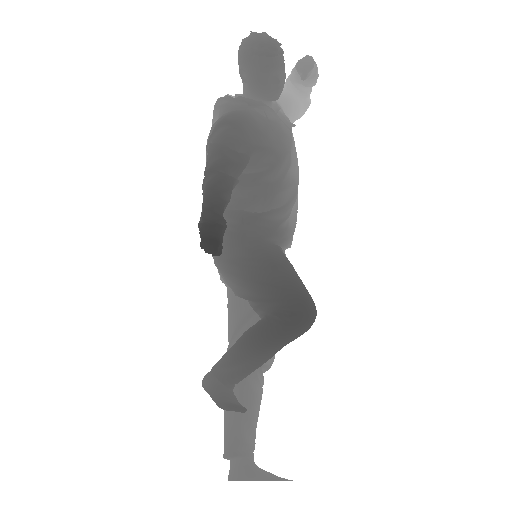
    After training of the implicit MLP, I got quite wired results. The reconstructed meshes are poor. 0_nc The evaluation results shows that NC is very low, but chamfer and p2s are very high. eval Do you know where the problem is? I would appreciate it a lot if you could give me some suggestions!
    opened by Zhangjzh 4
  • Question of  cloth refinement

    Question of cloth refinement

    Hi, I'm confused about local_affine_model in the cloth refinement. I find that you use the LocalAffine() converting the verts of the refinemesh to the affined verts. The step seems to train a Affinemodel. I know that we need get the loss between P_normal from the mesh and normal of the image to optimizer the verts, but I don't understand why we need introduct the Affinemodel. The procedure of localAffine is meaning getting the Affine Matrix under the Camera coordinate system? I confused about these.

    opened by Yuhuoo 1
  • Can't setup ICON on Ubuntu / Colab

    Can't setup ICON on Ubuntu / Colab

    Unfortunately, I can't manage to install ICON locally. The Colab Notebook and the model on Huggingface also seem to be broken. Would it be possible to update the documentation / environment or share a Docker file?

    opened by c6s0 4
  • how to get real depth value from depth map

    how to get real depth value from depth map

    Hi, recently I've been trying to use depth map as prior information, but how can I generate the point cloud at camera coordinate space or model space from the given depth map(generated by render_single.py) ? For example, how can i generate point cloud in camera/view space by depth_F/xxx.png below, i.e. how can i get the real depth value in camera space. I tried to see the coordinate transformation in the code, it seems that I can get perspective matrix and model_view matrix in lib/render/camer.py , which may transform the model from local space into clip space. But I am still confused about how to convert the depth map to another space.

    It would be very appricated if anyone could give me some advice!

    opened by mmmcn 2
  • scripts/render_single.sh: line 33: 137550 Killed

    scripts/render_single.sh: line 33: 137550 Killed

    ubuntu 22.04 + NVIDIA 2080Ti.

    I encountered this error when execute this script "bash scripts/render_batch.sh debug all".

    thuman2 START----------
    Debug renderer
    Rendering thuman2 0001
    /home/hcp/anaconda3/envs/metaverse/lib/python3.8/site-packages/scipy/__init__.py:146: UserWarning: A NumPy version >=1.16.5 and <1.23.0 is required for this version of SciPy (detected version 1.23.3
      warnings.warn(f"A NumPy version >={np_minversion} and <{np_maxversion}"
    
    **scripts/render_single.sh: line 33: 137550 Killed                  python $PYTHON_SCRIPT -s $SUBJECT -o $SAVE_DIR -r $NUM_VIEWS -w $SIZE**
    thuman2 END----------
    
    opened by hcp6897 1
  • A weird bug: The data is not on the same device.

    A weird bug: The data is not on the same device.

    https://github.com/YuliangXiu/ICON/blob/ece5a09aa2d56aec28017430e65a0352622a0f30/lib/dataset/mesh_util.py#L283

    ` print(triangles.device) # cuda:1

    print(points.device) # cuda:1

    residues, pts_ind, _ = point_to_mesh_distance(points, triangles)

    print(triangles.device) # cuda:1

    print(pts_ind.device) # cuda:0

    print(residues.device) # cuda:0`

    command: python -m apps.infer -cfg ./configs/icon-filter.yaml -gpu 1 -in_dir {*} -out_dir {*} 'CUDA_VISIBLE_DEVICES=1' doesn't work either.

    CUDA or OpenGL 
    opened by caiyongqi 11
Releases(v.1.1.0)
  • v.1.1.0(Aug 5, 2022)

    Important updates:

    • Support normal network training
    • New interactive demo deployed on HuggingFace space
    • Faster Google Colab environment setup
    • Improved clothing refinement module
    • Fix several bugs and refactor some messy functions
    Source code(tar.gz)
    Source code(zip)
  • v.1.0.0(Jun 15, 2022)

    The first stable version (ICON v.1.0.0) comes out!

    • Dataset: support THuman2.0
    • Inference: support PyMAF, PIXIE, PARE, HybrIK, BEV
    • Training & Evaluation: support PIFu, PaMIR, ICON
    • Add-on: garment extraction from fashion images
    Source code(tar.gz)
    Source code(zip)
  • v.1.0.0-rc2(Mar 7, 2022)

    Some updates:

    • HPS support: PyMAF (SMPL), PARE (SMPL), PIXIE (SMPL-X)
    • Google Colab support
    • Replace bvh-distance-queries with PyTorch3D and Kaolin to improve CUDA compatibility
    • Fix some issues
    Source code(tar.gz)
    Source code(zip)
  • v.1.0.0-rc1(Jan 30, 2022)

    First commit of ICON:

    • image-based inference code
    • pretrained model of ICON, PIFu*, PaMIR* (*: self-implementation)
    • homepage: https://icon.is.tue.mpg.de
    Source code(tar.gz)
    Source code(zip)
Owner
Yuliang Xiu
Ph.D. Student in Graphics & Vision
Yuliang Xiu
Multi-query Video Retreival

Multi-query Video Retreival

Princeton Visual AI Lab 17 Nov 22, 2022
Action Segmentation Evaluation

Reference Action Segmentation Evaluation Code This repository contains the reference code for action segmentation evaluation. If you have a bug-fix/im

5 May 22, 2022
Style-based Point Generator with Adversarial Rendering for Point Cloud Completion (CVPR 2021)

Style-based Point Generator with Adversarial Rendering for Point Cloud Completion (CVPR 2021) An efficient PyTorch library for Point Cloud Completion.

Microsoft 119 Jan 02, 2023
Many Class Activation Map methods implemented in Pytorch for CNNs and Vision Transformers. Including Grad-CAM, Grad-CAM++, Score-CAM, Ablation-CAM and XGrad-CAM

Class Activation Map methods implemented in Pytorch pip install grad-cam ⭐ Tested on many Common CNN Networks and Vision Transformers. ⭐ Includes smoo

Jacob Gildenblat 6.6k Jan 06, 2023
The implementation of ICASSP 2020 paper "Pixel-level self-paced learning for super-resolution"

Pixel-level Self-Paced Learning for Super-Resolution This is an official implementaion of the paper Pixel-level Self-Paced Learning for Super-Resoluti

Elon Lin 41 Dec 15, 2022
Music Generation using Neural Networks Streamlit App

Music_Gen_Streamlit "Music Generation using Neural Networks" Streamlit App TO DO: Make a run_app.sh Introduction [~5 min] (Sohaib) Team Member names/i

Muhammad Sohaib Arshid 6 Aug 09, 2022
This is the official repository of XVFI (eXtreme Video Frame Interpolation)

XVFI This is the official repository of XVFI (eXtreme Video Frame Interpolation), https://arxiv.org/abs/2103.16206 Last Update: 20210607 We provide th

Jihyong Oh 195 Dec 29, 2022
Utilities to bridge Canvas-generated course rosters with GitLab's API.

gitlab-canvas-utils A collection of scripts originally written for CSE 13S. Oversees everything from GitLab course group creation, student repository

Eugene Chou 5 Jun 08, 2022
FinGAT: A Financial Graph Attention Networkto Recommend Top-K Profitable Stocks

FinGAT: A Financial Graph Attention Networkto Recommend Top-K Profitable Stocks This is our implementation for the paper: FinGAT: A Financial Graph At

Yu-Che Tsai 64 Dec 13, 2022
Viewmaker Networks: Learning Views for Unsupervised Representation Learning

Viewmaker Networks: Learning Views for Unsupervised Representation Learning Alex Tamkin, Mike Wu, and Noah Goodman Paper link: https://arxiv.org/abs/2

Alex Tamkin 31 Dec 01, 2022
QuALITY: Question Answering with Long Input Texts, Yes!

QuALITY: Question Answering with Long Input Texts, Yes! Authors: Richard Yuanzhe Pang,* Alicia Parrish,* Nitish Joshi,* Nikita Nangia, Jason Phang, An

ML² AT CILVR 61 Jan 02, 2023
[ WSDM '22 ] On Sampling Collaborative Filtering Datasets

On Sampling Collaborative Filtering Datasets This repository contains the implementation of many popular sampling strategies, along with various expli

Noveen Sachdeva 17 Dec 08, 2022
(3DV 2021 Oral) Filtering by Cluster Consistency for Large-Scale Multi-Image Matching

Scalable Cluster-Consistency Statistics for Robust Multi-Object Matching (3DV 2021 Oral Presentation) Filtering by Cluster Consistency (FCC) is a very

Yunpeng Shi 11 Sep 28, 2022
Simulating Sycamore quantum circuits classically using tensor network algorithm.

Simulating the Sycamore quantum supremacy circuit This repo contains data we have obtained in simulating the Sycamore quantum supremacy circuits with

Feng Pan 46 Nov 17, 2022
Official implementation of Rich Semantics Improve Few-Shot Learning (BMVC, 2021)

Rich Semantics Improve Few-Shot Learning Paper Link Abstract : Human learning benefits from multi-modal inputs that often appear as rich semantics (e.

Mohamed Afham 11 Jul 26, 2022
Repositório criado para abrigar os notebooks com a listas de exercícios propostos pelo professor Gustavo Guanabara do canal Curso em Vídeo do YouTube durante o Curso de Python 3

Curso em Vídeo - Exercícios de Python 3 Sobre o repositório Este repositório contém os notebooks com a listas de exercícios propostos pelo professor G

João Pedro Pereira 9 Oct 15, 2022
PyTorch original implementation of Cross-lingual Language Model Pretraining.

XLM NEW: Added XLM-R model. PyTorch original implementation of Cross-lingual Language Model Pretraining. Includes: Monolingual language model pretrain

Facebook Research 2.7k Dec 27, 2022
TCNN Temporal convolutional neural network for real-time speech enhancement in the time domain

TCNN Pandey A, Wang D L. TCNN: Temporal convolutional neural network for real-time speech enhancement in the time domain[C]//ICASSP 2019-2019 IEEE Int

凌逆战 16 Dec 30, 2022
Face Mask Detection is a project to determine whether someone is wearing mask or not, using deep neural network.

face-mask-detection Face Mask Detection is a project to determine whether someone is wearing mask or not, using deep neural network. It contains 3 scr

amirsalar 13 Jan 18, 2022
PyTorch implementation of Value Iteration Networks (VIN): Clean, Simple and Modular. Visualization in Visdom.

VIN: Value Iteration Networks This is an implementation of Value Iteration Networks (VIN) in PyTorch to reproduce the results.(TensorFlow version) Key

Xingdong Zuo 215 Dec 07, 2022