Implementation of "Fast and Flexible Temporal Point Processes with Triangular Maps" (Oral @ NeurIPS 2020)

Overview

Fast and Flexible Temporal Point Processes with Triangular Maps
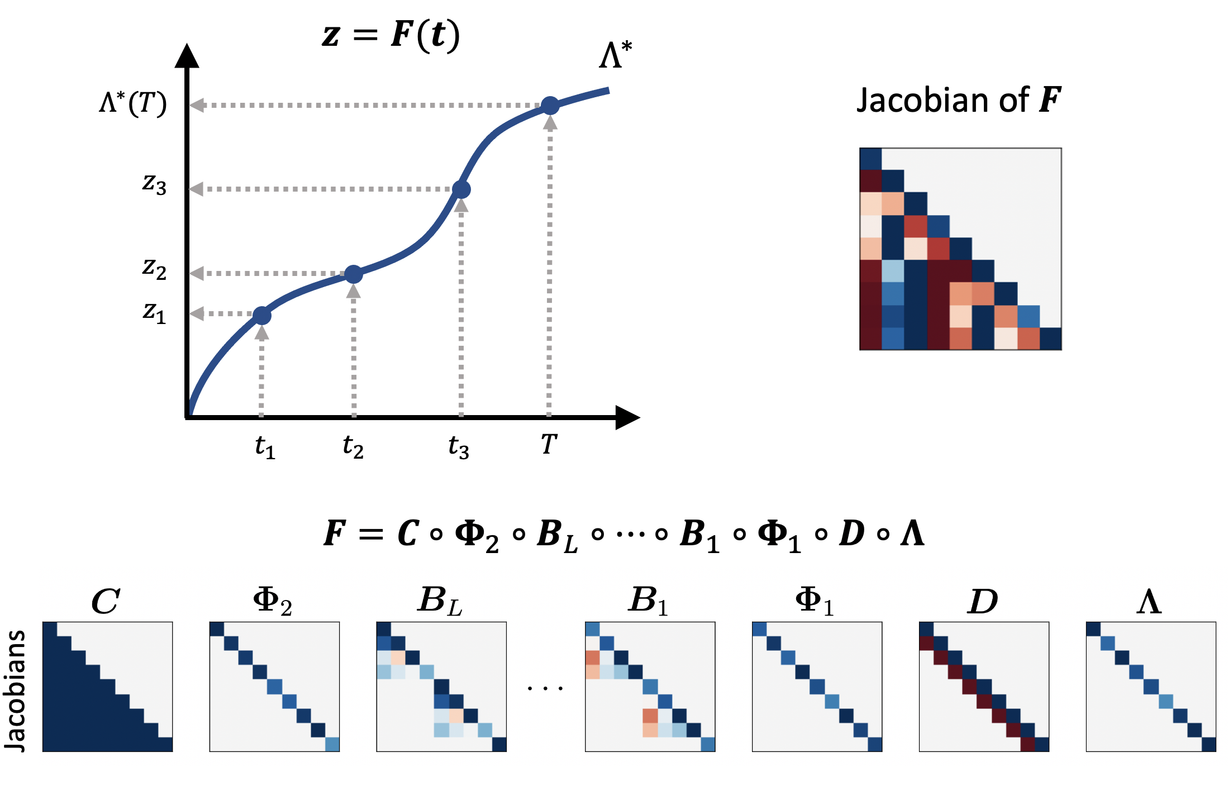
This repository includes a reference implementation of the algorithms described in "Fast and Flexible Temporal Point Processes with Triangular Maps" by Oleksandr Shchur, Nicholas Gao, Marin Biloš and Stephan Günnemann (Oral, NeurIPS 2020).

Temporal point processes (TPPs) allow us to define probability distributions over variable-length event sequences in some time interval [0, t_max]. In our paper, we show how to define TPPs using invertible transformations, similar to normalizing flows. The code includes new parametrizations for several existing TPPs as well as a new, more flexible model. Our parametrizations allow to both draw samples & compute likelihood in parallel, which leads to signficant speedups compared to traditional RNN-based models.

The following models are available in ttpp.models:

  • Inhomogeneous Poisson Process
  • Renewal Process
  • Modulated Renewal Process
  • TriTPP
  • Autoregressive (RNN-based TPP with slow sampling)

Requirements

The code is written in Python version 3.7 and was tested on Ubuntu 18.04. The code requires PyTorch version 1.5 with CUDA enabled. Other requirements are listed in requirements.txt.

To install the library run

pip install -e .

The datasets used in the paper can be found in data/.

Usage

Jupyter notebooks reproducing the experimental results can be found in the notebooks/ folder:

You can also train the model using command line. For example, to train the TriTPP model on the taxi dataset run

python scripts/experiment.py taxi TriTPP

To see the command line arguments, use

python scripts/experiment.py --help

Cite

Please cite our paper if you use this code or data in your own work:

@inproceedings{shchur2020fast,
  title = {Fast and Flexible Temporal Point Processes with Triangular Maps},
  author = {Shchur, Oleksandr and Gao, Nicholas and Bilo\v{s}, Marin and G{\"u}nnemann, Stephan},
  booktitle={Advances in Neural Information Processing Systems (NeurIPS)},
  year = {2020} 
}
Owner
Oleksandr Shchur
PhD student in Machine Learning at Technical University of Munich
Oleksandr Shchur
Code corresponding to The Introspective Agent: Interdependence of Strategy, Physiology, and Sensing for Embodied Agents

The Introspective Agent: Interdependence of Strategy, Physiology, and Sensing for Embodied Agents This is the code corresponding to The Introspective

0 Jan 10, 2022
Code for ICML 2021 paper: How could Neural Networks understand Programs?

OSCAR This repository contains the source code of our ICML 2021 paper How could Neural Networks understand Programs?. Environment Run following comman

Dinglan Peng 115 Dec 17, 2022
This project provides the proof of the uniqueness of the equilibrium and the global asymptotic stability.

Delayed-cellular-neural-network This project provides the proof of the uniqueness of the equilibrium and the global asymptotic stability. There is als

4 Apr 28, 2022
Resources for the "Evaluating the Factual Consistency of Abstractive Text Summarization" paper

Evaluating the Factual Consistency of Abstractive Text Summarization Authors: Wojciech Kryściński, Bryan McCann, Caiming Xiong, and Richard Socher Int

Salesforce 165 Dec 21, 2022
Software that can generate photos from paintings, turn horses into zebras, perform style transfer, and more.

CycleGAN PyTorch | project page | paper Torch implementation for learning an image-to-image translation (i.e. pix2pix) without input-output pairs, for

Jun-Yan Zhu 11.5k Dec 30, 2022
GULAG: GUessing LAnGuages with neural networks

GULAG: GUessing LAnGuages with neural networks Classify languages in text via neural networks. Привет! My name is Egor. Was für ein herrliches Frühl

Egor Spirin 12 Sep 02, 2022
[NeurIPS 2021] Code for Unsupervised Learning of Compositional Energy Concepts

Unsupervised Learning of Compositional Energy Concepts This is the pytorch code for the paper Unsupervised Learning of Compositional Energy Concepts.

45 Nov 30, 2022
Hyperbolic Image Segmentation, CVPR 2022

Hyperbolic Image Segmentation, CVPR 2022 This is the implementation of paper Hyperbolic Image Segmentation (CVPR 2022). Repository structure assets :

Mina Ghadimi Atigh 46 Dec 29, 2022
Personalized Federated Learning using Pytorch (pFedMe)

Personalized Federated Learning with Moreau Envelopes (NeurIPS 2020) This repository implements all experiments in the paper Personalized Federated Le

Charlie Dinh 226 Dec 30, 2022
The code of paper 'Learning to Aggregate and Personalize 3D Face from In-the-Wild Photo Collection'

Learning to Aggregate and Personalize 3D Face from In-the-Wild Photo Collection Pytorch implemetation of paper 'Learning to Aggregate and Personalize

Tencent YouTu Research 136 Dec 29, 2022
Rax is a Learning-to-Rank library written in JAX

🦖 Rax: Composable Learning to Rank using JAX Rax is a Learning-to-Rank library written in JAX. Rax provides off-the-shelf implementations of ranking

Google 247 Dec 27, 2022
The repo for the paper "I3CL: Intra- and Inter-Instance Collaborative Learning for Arbitrary-shaped Scene Text Detection".

I3CL: Intra- and Inter-Instance Collaborative Learning for Arbitrary-shaped Scene Text Detection Updates | Introduction | Results | Usage | Citation |

33 Jan 05, 2023
PAIRED in PyTorch 🔥

PAIRED This codebase provides a PyTorch implementation of Protagonist Antagonist Induced Regret Environment Design (PAIRED), which was first introduce

UCL DARK Lab 46 Dec 12, 2022
Fast and Easy Infinite Neural Networks in Python

Neural Tangents ICLR 2020 Video | Paper | Quickstart | Install guide | Reference docs | Release notes Overview Neural Tangents is a high-level neural

Google 1.9k Jan 09, 2023
Speech Recognition is an important feature in several applications used such as home automation, artificial intelligence

Speech Recognition is an important feature in several applications used such as home automation, artificial intelligence, etc. This article aims to provide an introduction on how to make use of the S

RISHABH MISHRA 1 Feb 13, 2022
[NeurIPS 2021 Spotlight] Aligning Pretraining for Detection via Object-Level Contrastive Learning

SoCo [NeurIPS 2021 Spotlight] Aligning Pretraining for Detection via Object-Level Contrastive Learning By Fangyun Wei*, Yue Gao*, Zhirong Wu, Han Hu,

Yue Gao 139 Dec 14, 2022
Retinal Vessel Segmentation with Pixel-wise Adaptive Filters (ISBI 2022)

Official code of Retinal Vessel Segmentation with Pixel-wise Adaptive Filters and Consistency Training (ISBI 2022)

anonymous 14 Oct 27, 2022
Implementation of "Glancing Transformer for Non-Autoregressive Neural Machine Translation"

GLAT Implementation for the ACL2021 paper "Glancing Transformer for Non-Autoregressive Neural Machine Translation" Requirements Python = 3.7 Pytorch

117 Jan 09, 2023
More than a hundred strange attractors

dysts Analyze more than a hundred chaotic systems. Basic Usage Import a model and run a simulation with default initial conditions and parameter value

William Gilpin 185 Dec 23, 2022
Code for the paper: Sketch Your Own GAN

Sketch Your Own GAN Project | Paper | Youtube | Slides Our method takes in one or a few hand-drawn sketches and customizes an off-the-shelf GAN to mat

677 Dec 28, 2022