A hybrid SOTA solution of LiDAR panoptic segmentation with C++ implementations of point cloud clustering algorithms. ICCV21, Workshop on Traditional Computer Vision in the Age of Deep Learning

Overview

ICCVW21-TradiCV-Survey-of-LiDAR-Cluster

Motivation

In contrast to popular end-to-end deep learning LiDAR panoptic segmentation solutions, we propose a hybrid method with an existing semantic segmentation network to extract semantic information and a traditional LiDAR point cloud cluster algorithm to split each instance object. We argue geometry-based traditional clustering algorithms are worth being considered by showing a state-of-the-art performance among all published end-to-end deep learning solutions on the panoptic segmentation leaderboard of the SemanticKITTI dataset. To our best knowledge, we are the first to attempt the point cloud panoptic segmentation with clustering algorithms. Therefore, instead of working on new models, we give a comprehensive technical survey in this paper by implementing four typical cluster methods and report their performances on the benchmark. Those four cluster methods are the most representative ones with real-time running speed. They are implemented with C++ in this paper and then wrapped as a python function for seamless integration with the existing deep learning frameworks.
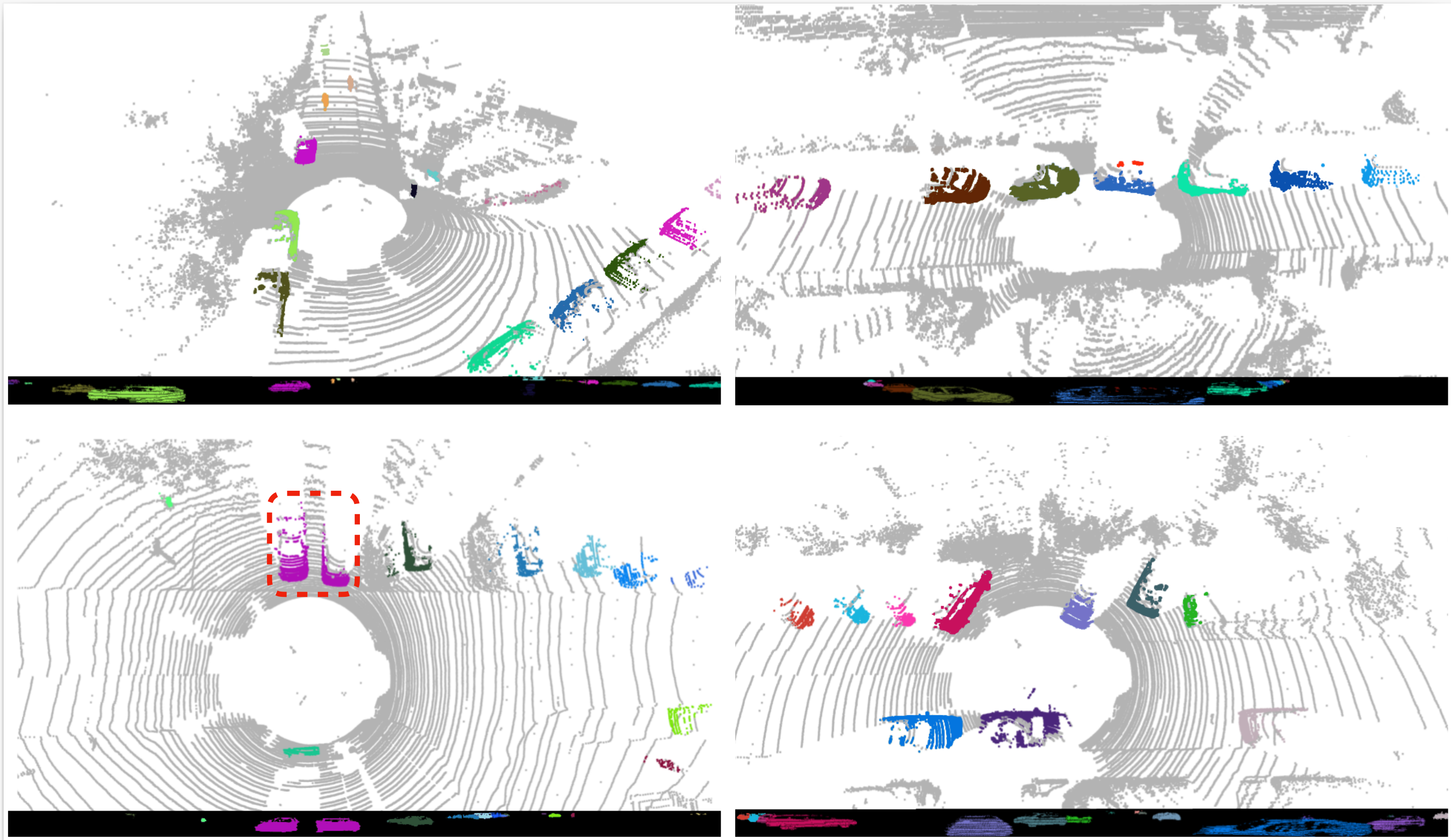

Figure


Dataset Organization

ICCVW21-LiDAR-Panoptic-Segmentation-TradiCV-Survey-of-Point-Cloud-Cluster
├──  Dataset
├        ├── semanticKITTI                 
├            ├── semantic-kitti-api-master         
├            ├── semantic-kitti.yaml
├            ├── data_odometry_velodyne ── dataset ── sequences ── train, val, test         # each folder contains the corresponding sequence folders 00,01...
├            ├── data_odometry_labels ── dataset ── sequences ── train, val, test           # each folder contains the corresponding sequence folders 00,01...
├            └── data_odometry_calib    
├──  method_predictions ── sequences

How to run

```
docker pull pytorch/pytorch:1.7.1-cuda11.0-cudnn8-runtime 
```

Install dependency packages:

```
bash install_dependency.sh
```

Compile specific clusters

```
cd PC_cluster
cd ScanLineRun_cluster/Euclidean_cluster/depth_cluster/SuperVoxel_cluster
bash prepare_packages.sh/prepare_pybind.sh
bash build.sh
```

Note, prepare_packages.sh may redundantly install packages as clusters are supposed to be used independently.

One can download the predicted validation results of Cylinder3D from here: https://drive.google.com/file/d/1QkV8zmRaOAgAZse5CGtlmijcLJVnh7XP/view?usp=sharing

We get the prediction of validation 08 sequence by using the provided checkpoint of Cylinder3D. Thanks for sharing the code!

After downloading, unzip the 08 file, put it inside ./method_predictions/sequences/

It looks like ./method_predictions/sequences/08/predictions/*.label

Run the cluster algorithm

```
python semantic_then_instance_post_inferece.py
```

It should keep updating the visualization figure output_example.png, and overwrite predicted labels in ./method_predictions/sequences/08/predictions/

One can unzip 08 again if wants to run the cluster algorithm again.

Some parameters can be tuned in args parser.

After generating the predicted panoptic label on validation set, one can simply run:

```
bash evaluation_panoptic.sh
```

Some changes of local path may need to be done. Just follow the error to change them, should be easy.

The reported numbers should be exactly the same as the paper since traditional methods have no randomness.

Publication

Please cite the paper if you use this code:

@inproceedings{zhao2021technical,
  title={A Technical Survey and Evaluation of Traditional Point Cloud Clustering Methods for LiDAR Panoptic Segmentation},
  author={Zhao, Yiming and Zhang, Xiao and Huang, Xinming},
  booktitle={Proceedings of the IEEE/CVF International Conference on Computer Vision},
  pages={2464--2473},
  year={2021}
}


Owner
YimingZhao
Job seeking at Shanghai. I'm a Ph.D. student at Worcester Polytechnic Institute, working on deep learning, autonomous driving, and general robotic vision.
YimingZhao
PyTorch implementation of paper: AdaAttN: Revisit Attention Mechanism in Arbitrary Neural Style Transfer, ICCV 2021.

AdaAttN: Revisit Attention Mechanism in Arbitrary Neural Style Transfer [Paper] [PyTorch Implementation] [Paddle Implementation] Overview This reposit

148 Dec 30, 2022
Extremely easy multi instancing software for minecraft speedrunning.

Easy Multi Extremely easy multi/single instancing software for minecraft speedrunning. A couple of goals of this project: Setup multi in minutes No fi

Duncan 8 Jul 16, 2022
Morphable Detector for Object Detection on Demand

Morphable Detector for Object Detection on Demand (ICCV 2021) PyTorch implementation of the paper Morphable Detector for Object Detection on Demand. I

9 Feb 23, 2022
(CVPR 2022) Energy-based Latent Aligner for Incremental Learning

Energy-based Latent Aligner for Incremental Learning Accepted to CVPR 2022 We illustrate an Incremental Learning model trained on a continuum of tasks

Joseph K J 37 Jan 03, 2023
A scanpy extension to analyse single-cell TCR and BCR data.

Scirpy: A Scanpy extension for analyzing single-cell immune-cell receptor sequencing data Scirpy is a scalable python-toolkit to analyse T cell recept

ICBI 145 Jan 03, 2023
DeepLabv3+:Encoder-Decoder with Atrous Separable Convolution语义分割模型在tensorflow2当中的实现

DeepLabv3+:Encoder-Decoder with Atrous Separable Convolution语义分割模型在tensorflow2当中的实现 目录 性能情况 Performance 所需环境 Environment 注意事项 Attention 文件下载 Download

Bubbliiiing 31 Nov 25, 2022
Full Stack Deep Learning Labs

Full Stack Deep Learning Labs Welcome! Project developed during lab sessions of the Full Stack Deep Learning Bootcamp. We will build a handwriting rec

Full Stack Deep Learning 1.2k Dec 31, 2022
Code for CoMatch: Semi-supervised Learning with Contrastive Graph Regularization

CoMatch: Semi-supervised Learning with Contrastive Graph Regularization (Salesforce Research) This is a PyTorch implementation of the CoMatch paper [B

Salesforce 107 Dec 14, 2022
This repository contains the source code of our work on designing efficient CNNs for computer vision

Efficient networks for Computer Vision This repo contains source code of our work on designing efficient networks for different computer vision tasks:

Sachin Mehta 386 Nov 26, 2022
Easy Parallel Library (EPL) is a general and efficient deep learning framework for distributed model training.

English | 简体中文 Easy Parallel Library Overview Easy Parallel Library (EPL) is a general and efficient library for distributed model training. Usability

Alibaba 185 Dec 21, 2022
Stacked Recurrent Hourglass Network for Stereo Matching

SRH-Net: Stacked Recurrent Hourglass Introduction This repository is supplementary material of our RA-L submission, which helps reviewers to understan

28 Jan 03, 2023
Deep Two-View Structure-from-Motion Revisited

Deep Two-View Structure-from-Motion Revisited This repository provides the code for our CVPR 2021 paper Deep Two-View Structure-from-Motion Revisited.

Jianyuan Wang 145 Jan 06, 2023
AbelNN: Deep Learning Python module from scratch

AbelNN: Deep Learning Python module from scratch I have implemented several neural networks from scratch using only Numpy. I have designed the module

Abel 2 Apr 12, 2022
Fast, modular reference implementation of Instance Segmentation and Object Detection algorithms in PyTorch.

Faster R-CNN and Mask R-CNN in PyTorch 1.0 maskrcnn-benchmark has been deprecated. Please see detectron2, which includes implementations for all model

Facebook Research 9k Jan 04, 2023
Bling's Object detection tool

BriVL for Building Applications This repo is used for illustrating how to build applications by using BriVL model. This repo is re-implemented from fo

chuhaojin 47 Nov 01, 2022
なりすまし検出(anti-spoof-mn3)のWebカメラ向けデモ

FaceDetection-Anti-Spoof-Demo なりすまし検出(anti-spoof-mn3)のWebカメラ向けデモです。 モデルはPINTO_model_zoo/191_anti-spoof-mn3からONNX形式のモデルを使用しています。 Requirement mediapipe

KazuhitoTakahashi 8 Nov 18, 2022
Pytorch implementation of NeurIPS 2021 paper: Geometry Processing with Neural Fields.

Geometry Processing with Neural Fields Pytorch implementation for the NeurIPS 2021 paper: Geometry Processing with Neural Fields Guandao Yang, Serge B

Guandao Yang 162 Dec 16, 2022
Self-Supervised CNN-GCN Autoencoder

GCNDepth Self-Supervised CNN-GCN Autoencoder GCNDepth: Self-supervised monocular depth estimation based on graph convolutional network To be published

53 Dec 14, 2022
Official PyTorch implementation of Segmenter: Transformer for Semantic Segmentation

Segmenter: Transformer for Semantic Segmentation Segmenter: Transformer for Semantic Segmentation by Robin Strudel*, Ricardo Garcia*, Ivan Laptev and

594 Jan 06, 2023
PyTorch-LIT is the Lite Inference Toolkit (LIT) for PyTorch which focuses on easy and fast inference of large models on end-devices.

PyTorch-LIT PyTorch-LIT is the Lite Inference Toolkit (LIT) for PyTorch which focuses on easy and fast inference of large models on end-devices. With

Amin Rezaei 157 Dec 11, 2022