Visualizing Yolov5's layers using GradCam

Overview

YOLO-V5 GRADCAM

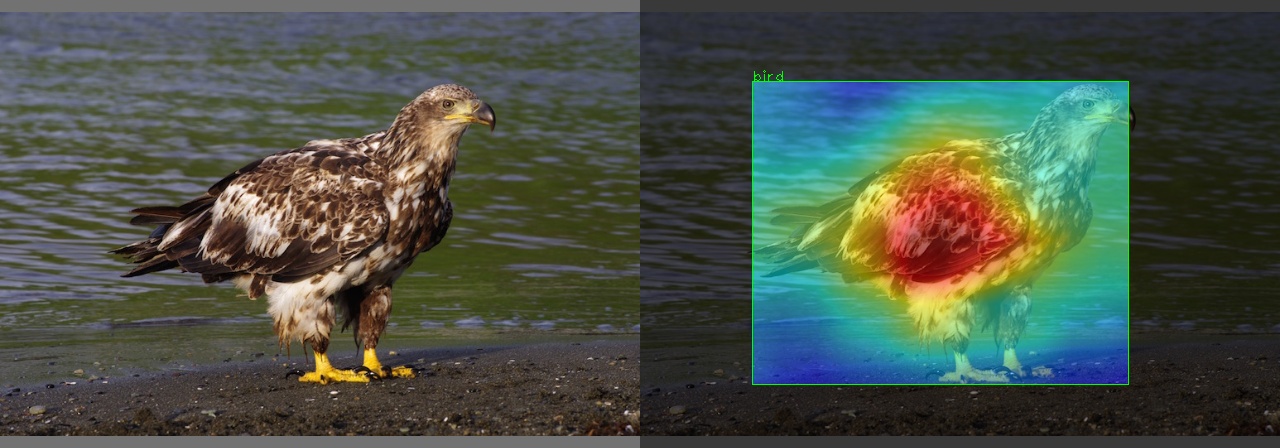
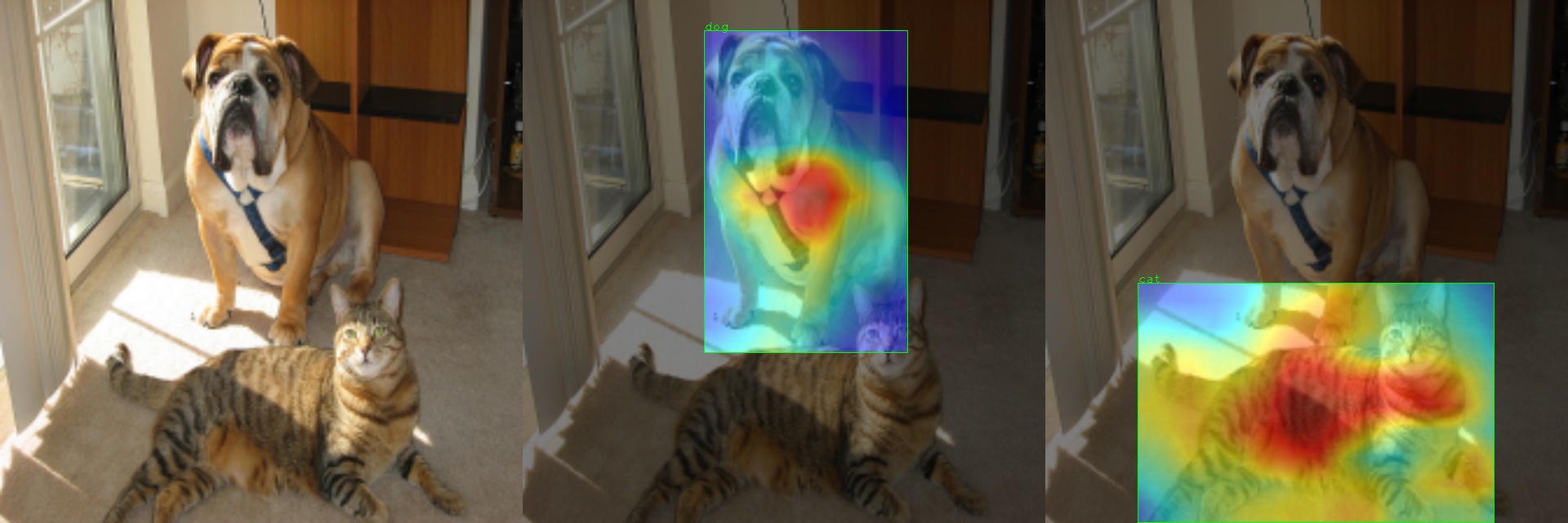
I constantly desired to know to which part of an object the object-detection models pay more attention. So I searched for it, but I didn't find any for Yolov5. Here is my implementation of Grad-cam for YOLO-v5. To load the model I used the yolov5's main codes, and for computing GradCam I used the codes from the gradcam_plus_plus-pytorch repository. Please follow my GitHub account and star the project if this functionality benefits your research or projects.

Installation

pip install -r requirements.txt

Infer

python main.py --model-path yolov5s.pt --img-path images/cat-dog.jpg --output-dir outputs

NOTE: If you don't have any weights and just want to test, don't change the model-path argument. The yolov5s model will be automatically downloaded thanks to the download function from yolov5.

NOTE: For more input arguments, check out the main.py or run the following command:

python main.py -h

Examples

Open In Colab

cat&dog

cat&dog

cat&dog

Note

I checked the code, but I couldn't find an explanation for why the truck's heatmap does not show anything. Please inform me or create a pull request if you find the reason.

TO Do

  1. Add GradCam++
  2. Add ScoreCam
  3. Add the functionality to the deep_utils library

References

  1. https://github.com/1Konny/gradcam_plus_plus-pytorch
  2. https://github.com/ultralytics/yolov5
  3. https://github.com/pooya-mohammadi/deep_utils

Citation

Please cite yolov5-gradcam if it helps your research. You can use the following BibTeX entry:

@misc{deep_utils,
	title = {yolov5-gradcam},
	author = {Mohammadi Kazaj, Pooya},
	howpublished = {\url{github.com/pooya-mohammadi/yolov5-gradcam}},
	year = {2021}
}
Owner
Pooya Mohammadi Kazaj
Open Source Enthusiast | AI Developer & Researcher
Pooya Mohammadi Kazaj
[ICCV 2021] A Simple Baseline for Semi-supervised Semantic Segmentation with Strong Data Augmentation

[ICCV 2021] A Simple Baseline for Semi-supervised Semantic Segmentation with Strong Data Augmentation

CodingMan 45 Dec 12, 2022
ILVR: Conditioning Method for Denoising Diffusion Probabilistic Models (ICCV 2021 Oral)

ILVR + ADM This is the implementation of ILVR: Conditioning Method for Denoising Diffusion Probabilistic Models (ICCV 2021 Oral). This repository is h

Jooyoung Choi 225 Dec 28, 2022
Rafael Project- Classifying rockets to different types using data science algorithms.

Rocket-Classify Rafael Project- Classifying rockets to different types using data science algorithms. In this project we received data base with data

Hadassah Engel 5 Sep 18, 2021
Pytorch implementation of SenFormer: Efficient Self-Ensemble Framework for Semantic Segmentation

SenFormer: Efficient Self-Ensemble Framework for Semantic Segmentation Efficient Self-Ensemble Framework for Semantic Segmentation by Walid Bousselham

61 Dec 26, 2022
Flow is a computational framework for deep RL and control experiments for traffic microsimulation.

Flow Flow is a computational framework for deep RL and control experiments for traffic microsimulation. See our website for more information on the ap

867 Jan 02, 2023
CellRank's reproducibility repository.

CellRank's reproducibility repository We believe that reproducibility is key and have made it as simple as possible to reproduce our results. Please e

Theis Lab 8 Oct 08, 2022
*ObjDetApp* deploys a pytorch model for object detection

*ObjDetApp* deploys a pytorch model for object detection

Will Chao 1 Dec 26, 2021
Object-Centric Learning with Slot Attention

Slot Attention This is a re-implementation of "Object-Centric Learning with Slot Attention" in PyTorch (https://arxiv.org/abs/2006.15055). Requirement

Untitled AI 72 Jan 02, 2023
ManiSkill-Learn is a framework for training agents on SAPIEN Open-Source Manipulation Skill Challenge (ManiSkill Challenge), a large-scale learning-from-demonstrations benchmark for object manipulation.

ManiSkill-Learn ManiSkill-Learn is a framework for training agents on SAPIEN Open-Source Manipulation Skill Challenge, a large-scale learning-from-dem

Hao Su's Lab, UCSD 48 Dec 30, 2022
Introduction to CPM

CPM CPM is an open-source program on large-scale pre-trained models, which is conducted by Beijing Academy of Artificial Intelligence and Tsinghua Uni

Tsinghua AI 136 Dec 23, 2022
🛠 All-in-one web-based IDE specialized for machine learning and data science.

All-in-one web-based development environment for machine learning Getting Started • Features & Screenshots • Support • Report a Bug • FAQ • Known Issu

Machine Learning Tooling 2.9k Jan 09, 2023
STARCH compuets regional extreme storm physical characteristics and moisture balance based on spatiotemporal precipitation data from reanalysis or climate model data.

STARCH (Storm Tracking And Regional CHaracterization) STARCH computes regional extreme storm physical and moisture balance characteristics based on sp

Onosama 7 Oct 20, 2022
Solution of Kaggle competition: Sartorius - Cell Instance Segmentation

Sartorius - Cell Instance Segmentation https://www.kaggle.com/c/sartorius-cell-instance-segmentation Environment setup Build docker image bash .dev_sc

68 Dec 09, 2022
《K-Adapter: Infusing Knowledge into Pre-Trained Models with Adapters》(2020)

K-Adapter: Infusing Knowledge into Pre-Trained Models with Adapters This repository is the implementation of the paper "K-Adapter: Infusing Knowledge

Microsoft 118 Dec 13, 2022
Template repository to build PyTorch projects from source on any version of PyTorch/CUDA/cuDNN.

The Ultimate PyTorch Source-Build Template Translations: 한국어 TL;DR PyTorch built from source can be x4 faster than a naïve PyTorch install. This repos

Joonhyung Lee/이준형 651 Dec 12, 2022
Liver segmentation using MONAI and pytorch

Machine Learning use case in the field of Healthcare. In this project MONAI and pytorch frameworks are used for 3D Liver segmentation.

Abhishek Gajbhiye 2 May 30, 2022
HyperPose is a library for building high-performance custom pose estimation applications.

HyperPose is a library for building high-performance custom pose estimation applications.

TensorLayer Community 1.2k Jan 04, 2023
Code for Paper Predicting Osteoarthritis Progression via Unsupervised Adversarial Representation Learning

Predicting Osteoarthritis Progression via Unsupervised Adversarial Representation Learning (c) Tianyu Han and Daniel Truhn, RWTH Aachen University, 20

Tianyu Han 7 Nov 22, 2022
Code for the paper: Adversarial Training Against Location-Optimized Adversarial Patches. ECCV-W 2020.

Adversarial Training Against Location-Optimized Adversarial Patches arXiv | Paper | Code | Video | Slides Code for the paper: Sukrut Rao, David Stutz,

Sukrut Rao 32 Dec 13, 2022
A Java implementation of the experiments for the paper "k-Center Clustering with Outliers in Sliding Windows"

OutliersSlidingWindows A Java implementation of the experiments for the paper "k-Center Clustering with Outliers in Sliding Windows" Dataset generatio

PaoloPellizzoni 0 Jan 05, 2022