(ACL 2022) The source code for the paper "Towards Abstractive Grounded Summarization of Podcast Transcripts"

Overview

Towards Abstractive Grounded Summarization of Podcast Transcripts

We provide the source code for the paper "Towards Abstractive Grounded Summarization of Podcast Transcripts" accepted at ACL'22. If you find the code useful, please cite the following paper.

@inproceedings{song-etal-2022-grounded,
    title="Towards Abstractive Grounded Summarization of Podcast Transcripts",
    author = "Song, Kaiqiang and
              Li, Chen and
              Wang, Xiaoyang and
              Yu, Dong and
              Liu, Fei",
    booktitle={Proceedings of the 60th Annual Meeting of the Association for Computational Linguistics},
    year={2022}
}

Goal

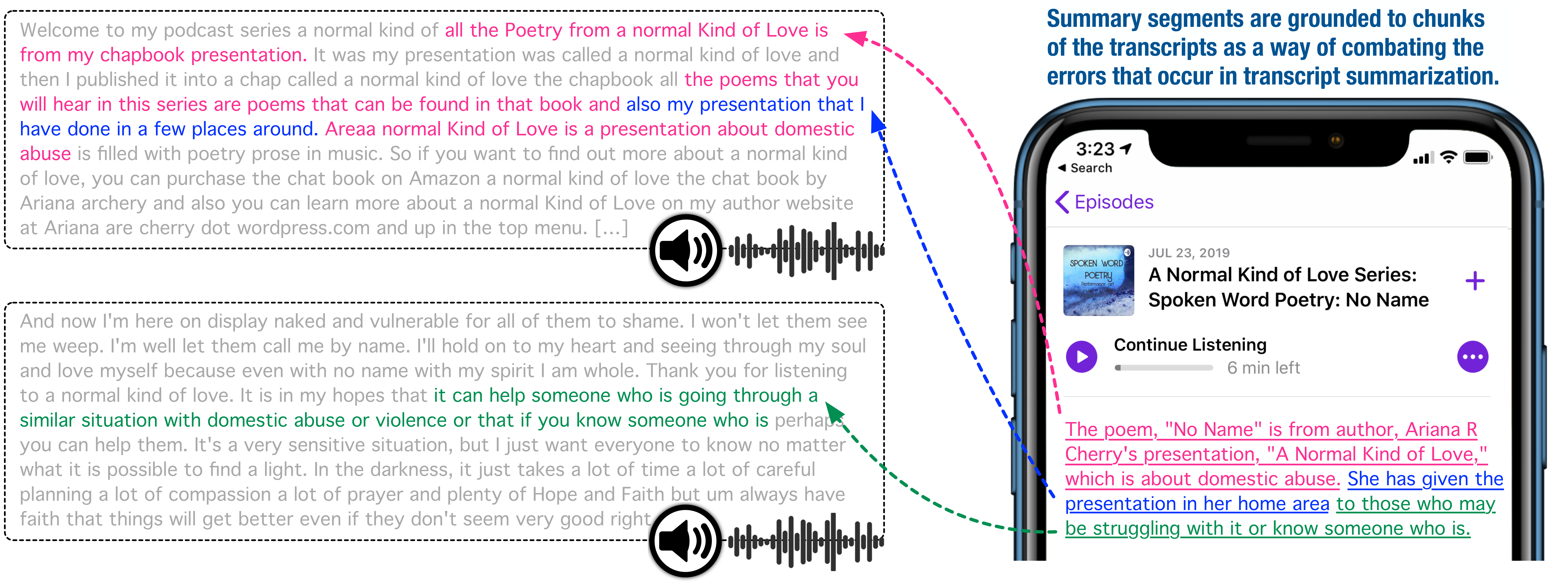
We proposed a grounded summarization system, which provide each summary sentence a linked chunk of the original transcripts and their audio/video recordings. It allows a human evaluator to quickly verify the summary content against source clips. example
News

  • 03/04/2022 Trained model and processed testing data released.
  • 03/03/2022 Code Released. Paper link, trained model and processed testing data will be released soon.
  • 02/23/2022 Paper accepted at ACL 2022.

Experiments

You can follow the below 4 steps to generate grounded podcast summaries or directly download the generated summary from this link

Step 1: Download Code, Model & Data

Download the code

git clone https://github.com/tencent-ailab/GrndPodcastSum.git
cd GrndPodcastSum

Download the Trained Models to GrndPodcastSum Directory and unzip

unzip model.zip

Download the Processed Test Set (1027) to GrndPodcastSum Directory and unzip

unzip data.zip

Step 2: Setup Environment

Create the environment using .yml file.

conda env create -f env.yml
conda activate GrndPodcastSum

Step 3. Offline Computing for Chunk Embeddings

Calculating the chunk embedding offline.

sh offline.sh

Step 4. Generating Grounded Summary

Use Grnd-token-nonoveralp model to generate summary.

sh test.sh

License

Copyright 2022 Tencent

Licensed under the Apache License, Version 2.0 (the "License"); you may not use this file except in compliance with the License. You may obtain a copy of the License at

   http://www.apache.org/licenses/LICENSE-2.0

Unless required by applicable law or agreed to in writing, software distributed under the License is distributed on an "AS IS" BASIS, WITHOUT WARRANTIES OR CONDITIONS OF ANY KIND, either express or implied. See the License for the specific language governing permissions and limitations under the License.

Disclaimer

This repo is only for research purpose. It is not an officially supported Tencent product.

Owner
Research repositories.
Must-read papers on improving efficiency for pre-trained language models.

Must-read papers on improving efficiency for pre-trained language models.

Tobias Lee 89 Jan 03, 2023
Official implementation of MLP Singer: Towards Rapid Parallel Korean Singing Voice Synthesis

MLP Singer Official implementation of MLP Singer: Towards Rapid Parallel Korean Singing Voice Synthesis. Audio samples are available on our demo page.

Neosapience 103 Dec 23, 2022
ProtFeat is protein feature extraction tool that utilizes POSSUM and iFeature.

Description: ProtFeat is designed to extract the protein features by employing POSSUM and iFeature python-based tools. ProtFeat includes a total of 39

GOKHAN OZSARI 5 Dec 16, 2022
Sapiens is a human antibody language model based on BERT.

Sapiens: Human antibody language model ____ _ / ___| __ _ _ __ (_) ___ _ __ ___ \___ \ / _` | '_ \| |/ _ \ '

Merck Sharp & Dohme Corp. a subsidiary of Merck & Co., Inc. 13 Nov 20, 2022
State of the art faster Natural Language Processing in Tensorflow 2.0 .

tf-transformers: faster and easier state-of-the-art NLP in TensorFlow 2.0 ****************************************************************************

74 Dec 05, 2022
This project uses word frequency and Term Frequency-Inverse Document Frequency to summarize a text.

Text Summarizer This project uses word frequency and Term Frequency-Inverse Document Frequency to summarize a text. Team Members This mini-project was

1 Nov 16, 2021
Code examples for my Write Better Python Code series on YouTube.

Write Better Python Code This repository contains the code examples used in my Write Better Python Code series published on YouTube: https:/

858 Dec 29, 2022
Uses Google's gTTS module to easily create robo text readin' on command.

Tool to convert text to speech, creating files for later use. TTRS uses Google's gTTS module to easily create robo text readin' on command.

0 Jun 20, 2021
Code of paper: A Recurrent Vision-and-Language BERT for Navigation

Recurrent VLN-BERT Code of the Recurrent-VLN-BERT paper: A Recurrent Vision-and-Language BERT for Navigation Yicong Hong, Qi Wu, Yuankai Qi, Cristian

YicongHong 109 Dec 21, 2022
Natural Language Processing Specialization

Natural Language Processing Specialization In this folder, Natural Language Processing Specialization projects and notes can be found. WHAT I LEARNED

Kaan BOKE 3 Oct 06, 2022
Trankit is a Light-Weight Transformer-based Python Toolkit for Multilingual Natural Language Processing

Trankit: A Light-Weight Transformer-based Python Toolkit for Multilingual Natural Language Processing Trankit is a light-weight Transformer-based Pyth

652 Jan 06, 2023
Generating Korean Slogans with phonetic and structural repetition

LexPOS_ko Generating Korean Slogans with phonetic and structural repetition Generating Slogans with Linguistic Features LexPOS is a sequence-to-sequen

Yeoun Yi 3 May 23, 2022
Natural language computational chemistry command line interface.

nlcc Install pip install nlcc Must have Open-AI Codex key: export OPENAI_API_KEY=your key here then nlcc key bindings ctrl-w copy to clipboard (Note

Andrew White 37 Dec 14, 2022
Unsupervised Document Expansion for Information Retrieval with Stochastic Text Generation

Unsupervised Document Expansion for Information Retrieval with Stochastic Text Generation Official Code Repository for the paper "Unsupervised Documen

NLP*CL Laboratory 2 Oct 26, 2021
BERTopic is a topic modeling technique that leverages 🤗 transformers and c-TF-IDF to create dense clusters allowing for easily interpretable topics whilst keeping important words in the topic descriptions

BERTopic BERTopic is a topic modeling technique that leverages 🤗 transformers and c-TF-IDF to create dense clusters allowing for easily interpretable

Maarten Grootendorst 3.6k Jan 07, 2023
Code repository of the paper Neural circuit policies enabling auditable autonomy published in Nature Machine Intelligence

Code repository of the paper Neural circuit policies enabling auditable autonomy published in Nature Machine Intelligence

9 Jan 08, 2023
Multilingual finetuning of Machine Translation model on low-resource languages. Project for Deep Natural Language Processing course.

Low-resource-Machine-Translation This repository contains the code for the project relative to the course Deep Natural Language Processing. The goal o

Andrea Cavallo 3 Jun 22, 2022
BERTAC (BERT-style transformer-based language model with Adversarially pretrained Convolutional neural network)

BERTAC (BERT-style transformer-based language model with Adversarially pretrained Convolutional neural network) BERTAC is a framework that combines a

6 Jan 24, 2022
Perform sentiment analysis on textual data that people generally post on websites like social networks and movie review sites.

Sentiment Analyzer The goal of this project is to perform sentiment analysis on textual data that people generally post on websites like social networ

Madhusudan.C.S 53 Mar 01, 2022
Applying "Load What You Need: Smaller Versions of Multilingual BERT" to LaBSE

smaller-LaBSE LaBSE(Language-agnostic BERT Sentence Embedding) is a very good method to get sentence embeddings across languages. But it is hard to fi

Jeong Ukjae 13 Sep 02, 2022