Learning where to learn - Gradient sparsity in meta and continual learning

Overview

Learning where to learn - Gradient sparsity in meta and continual learning

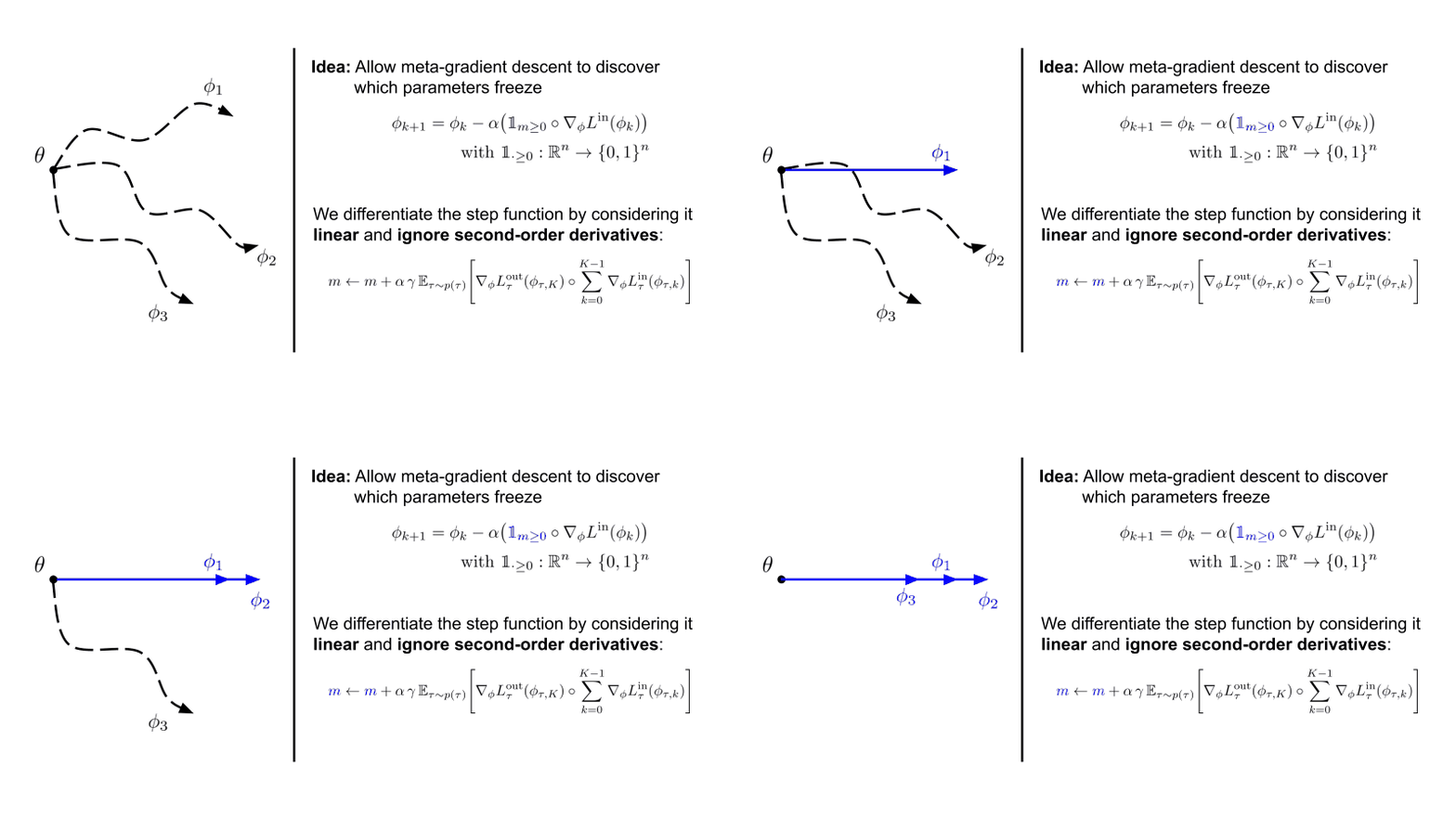
In this paper, we investigate gradient sparsity found by MAML in various continual and few-shot learning scenarios.
Instead of only learning the initialization of neural network parameters, we additionally meta-learn parameters underneath a step function that stops gradient descent when smaller then 0.

We term this version Sparse-MAML - Link to the paper here.
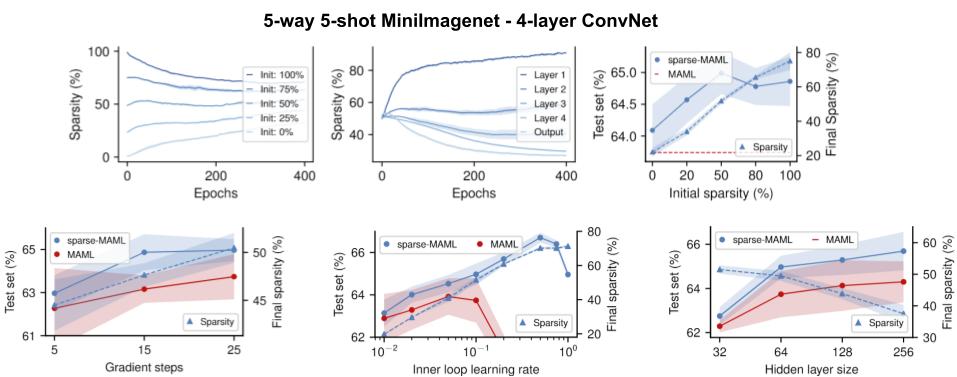
Interestingly, we see that structured sparsity emerges in both the classic 4-layer ConvNet as well as a ResNet-12 for few-shot learning. This is accompanied by improved robustness and generalisation across many hyperparameters.
Note that Sparse-MAML is an extremely simple variant of MAML that possesses only the possibility to shut on/off training of specific parameters compared to proper gradient modulation.

This codebase implents the few-shot learning experiments that are presented in the paper. To reproduce the results in the paper, please follow these instructions:

Installation

#1. Install a conda env:

conda create -n sparse-MAML

#2. Activate the env:

source activate sparse-MAML

#3. Install anaconda:

conda install anaconda

#4. Install extra requiremetns (make sure you use the correct pip3):

pip3 install -r requirements.txt

#5. Run:

chmod u+x run_sparse_MAML.sh

#6. Execute:

./run_sparse_MAML.sh

Results

MiniImageNet Few-Shot MAML ANIL BOIL sparse-MAML sparse-ReLU-MAML
5-way 5-shot | ConvNet 63.15 61.50 66.45 67.03 64.84
5-way 1-shot | ConvNet 48.07 46.70 49.61 50.35 50.39
5-way 5-shot | ResNet12 69.36 70.03 70.50 70.02 73.01
5-way 1-shot | ResNet12 53.91 55.25 - 55.02 56.39

BOIL results are taken from the original paper.


This code based is heavily build on top of torchmeta.

Owner
Johannes Oswald
Johannes Oswald
Bunch of different tools which helps visualizing and annotating images for semantic/instance segmentation tasks

Data Framework for Semantic/Instance Segmentation Bunch of different tools which helps visualizing, transforming and annotating images for semantic/in

Bruno Fernandes Carvalho 5 Dec 21, 2022
Bringing sanity to world of messed-up data

Sanitize sanitize is a Python module for making sure various things (e.g. HTML) are safe to use. It was originally written by Mark Pilgrim and is dist

Alireza Savand 63 Oct 26, 2021
Code for "Modeling Indirect Illumination for Inverse Rendering", CVPR 2022

Modeling Indirect Illumination for Inverse Rendering Project Page | Paper | Data Preparation Set up the python environment conda create -n invrender p

ZJU3DV 116 Jan 03, 2023
TensorFlow-LiveLessons - "Deep Learning with TensorFlow" LiveLessons

TensorFlow-LiveLessons Note that the second edition of this video series is now available here. The second edition contains all of the content from th

Deep Learning Study Group 830 Jan 03, 2023
Code for our CVPR 2022 Paper "GEN-VLKT: Simplify Association and Enhance Interaction Understanding for HOI Detection"

GEN-VLKT Code for our CVPR 2022 paper "GEN-VLKT: Simplify Association and Enhance Interaction Understanding for HOI Detection". Contributed by Yue Lia

Yue Liao 47 Dec 04, 2022
Like ThreeJS but for Python and based on wgpu

pygfx A render engine, inspired by ThreeJS, but for Python and targeting Vulkan/Metal/DX12 (via wgpu). Introduction This is a Python render engine bui

139 Jan 07, 2023
Supporting code for "Autoregressive neural-network wavefunctions for ab initio quantum chemistry".

naqs-for-quantum-chemistry This repository contains the codebase developed for the paper Autoregressive neural-network wavefunctions for ab initio qua

Tom Barrett 24 Dec 23, 2022
alfred-py: A deep learning utility library for **human**

Alfred Alfred is command line tool for deep-learning usage. if you want split an video into image frames or combine frames into a single video, then a

JinTian 800 Jan 03, 2023
Repo for the ACMMM20 submission: "Personalized breath based biometric authentication with wearable multimodality".

personalized-breath Repo for the ACMMM20 submission: "Personalized breath based biometric authentication with wearable multimodality". Guideline To ex

Manh-Ha Bui 2 Nov 15, 2021
MultiTaskLearning - Multi Task Learning for 3D segmentation

Multi Task Learning for 3D segmentation Perception stack of an Autonomous Drivin

2 Sep 22, 2022
Code of the paper "Part Detector Discovery in Deep Convolutional Neural Networks" by Marcel Simon, Erik Rodner and Joachim Denzler

Part Detector Discovery This is the code used in our paper "Part Detector Discovery in Deep Convolutional Neural Networks" by Marcel Simon, Erik Rodne

Computer Vision Group Jena 17 Feb 22, 2022
Tensorflow implementation of ID-Unet: Iterative Soft and Hard Deformation for View Synthesis.

ID-Unet: Iterative-view-synthesis(CVPR2021 Oral) Tensorflow implementation of ID-Unet: Iterative Soft and Hard Deformation for View Synthesis. Overvie

17 Aug 23, 2022
UPSNet: A Unified Panoptic Segmentation Network

UPSNet: A Unified Panoptic Segmentation Network Introduction UPSNet is initially described in a CVPR 2019 oral paper. Disclaimer This repository is te

Uber Research 622 Dec 26, 2022
A Flow-based Generative Network for Speech Synthesis

WaveGlow: a Flow-based Generative Network for Speech Synthesis Ryan Prenger, Rafael Valle, and Bryan Catanzaro In our recent paper, we propose WaveGlo

NVIDIA Corporation 2k Dec 26, 2022
PyTorch implementation of residual gated graph ConvNets, ICLR’18

Residual Gated Graph ConvNets April 24, 2018 Xavier Bresson http://www.ntu.edu.sg/home/xbresson https://github.com/xbresson https://twitter.com/xbress

Xavier Bresson 112 Aug 10, 2022
[ICCV 2021] HRegNet: A Hierarchical Network for Large-scale Outdoor LiDAR Point Cloud Registration

HRegNet: A Hierarchical Network for Large-scale Outdoor LiDAR Point Cloud Registration Introduction The repository contains the source code and pre-tr

Intelligent Sensing, Perception and Computing Group 55 Dec 14, 2022
A package, and script, to perform imaging transcriptomics on a neuroimaging scan.

Imaging Transcriptomics Imaging transcriptomics is a methodology that allows to identify patterns of correlation between gene expression and some prop

Alessio Giacomel 10 Dec 27, 2022
PHOTONAI is a high level python API for designing and optimizing machine learning pipelines.

PHOTONAI is a high level python API for designing and optimizing machine learning pipelines. We've created a system in which you can easily select and

Medical Machine Learning Lab - University of Münster 57 Nov 12, 2022
A PyTorch implementation of EventProp [https://arxiv.org/abs/2009.08378], a method to train Spiking Neural Networks

Spiking Neural Network training with EventProp This is an unofficial PyTorch implemenation of EventProp, a method to compute exact gradients for Spiki

Pedro Savarese 35 Jul 29, 2022
Meta-meta-learning with evolution and plasticity

Evolve plastic networks to be able to automatically acquire novel cognitive (meta-learning) tasks

5 Jun 28, 2022