An Approach to Explore Logistic Regression Models

Related tags

Deep Learningucreg
Overview

User-centered Regression

An Approach to Explore Logistic Regression Models

This tool applies the potential of Attribute-RadViz in identifying correlations levels of attributes to explore LR models. We focus on reducing the limitations of using those models in multidimensional data contexts.

The tool includes the following aspects:

  • feature selection,
  • regression model construction,
  • evaluation of binary and multinomial regression, and
  • construction of a panorama for queries over the model.

Authors:

  • Erasmo Artur (USP)
  • Rosane Minghim (UCC)

Installing and running

  • Download this project and unzip in a local directory
  • Open the HTML file in a browser (tested in Chrome, Firefox, and Edge)

Getting started

  • Rendering the first view:
    • Go to Left panel->CSV File->Choose file to pick a CSV file.
    • Then choose a target attribute from Left panel->Target Attribute.
  • Generation of logistic regression models:
    • Select attributes clicking over them and click over the dimensional anchor of the desired label.

The interface
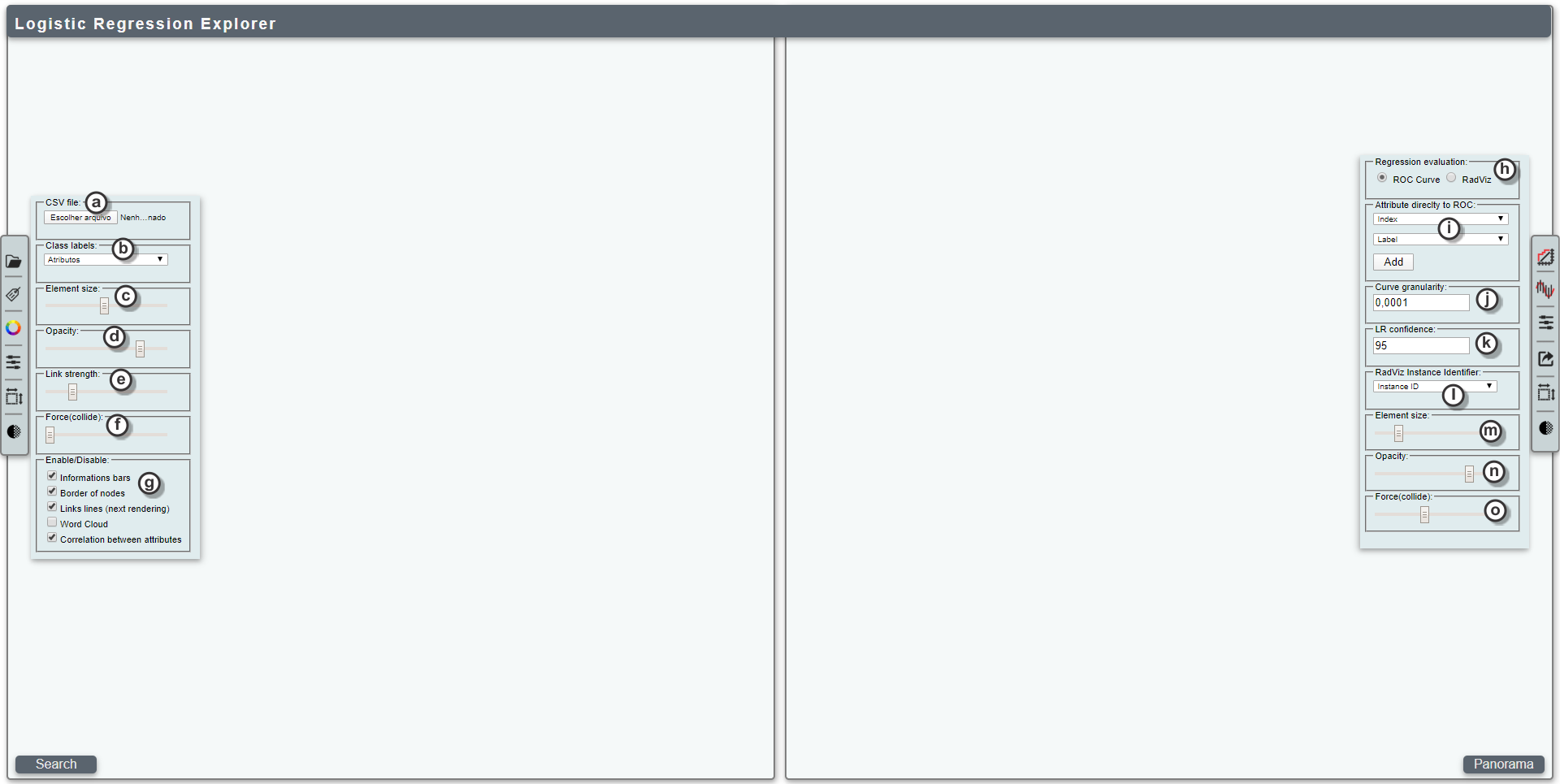
Screen of the interface

  • (a) File opener
  • (b) Target attribute selection
  • (c) Adjust the size of the elements
  • (d) Adjust the opacity of the elements
  • (e) Adjust the strength of RadViz links
  • (f) Adjust the repelling force of the elements (to avoid overlapping)
  • (g) Enable/disable visual widgets of the tool (can increase performance)
    • Information bars: Hide/Show all informations bars
    • Borders of nodes: Hide/Show the borders of the mapped elements
    • Links lines: Hide/Show between DAs and mapped elements
    • Word cloud: Hide/Show a word cloud when hovering DAs
    • Correlation between attributes: Dynamically changes sizes of elements according to the correlation to the hovered one.
  • (h) Choose the evaluation mode in the second view
  • (i) Plot some attribute of the data set directly to the ROC
  • (j) Choose the discretization of the ROC curve
  • (k) Choose the confindence of the LR model
  • (l) Choose the attribute used in to identify mapped items by the tooltip
  • (m) Define the sample size for the view
  • (n) Define the opacity of the elements
  • (o) Adjust the repelling force of the elements (to avoid overlapping)
Talk covering the features of skorch

Skorch Talk Skorch - A Union of Scikit-learn and PyTorch Presentation The slides can be downloaded at: download link. Google Colab Part One - MNIST Pa

Thomas J. Fan 3 Oct 20, 2020
Neural machine translation between the writings of Shakespeare and modern English using TensorFlow

Shakespeare translations using TensorFlow This is an example of using the new Google's TensorFlow library on monolingual translation going from modern

Motoki Wu 245 Dec 28, 2022
ML-based medical imaging using Azure

Disclaimer This code is provided for research and development use only. This code is not intended for use in clinical decision-making or for any other

Microsoft Azure 68 Dec 23, 2022
Autolfads-tf2 - A TensorFlow 2.0 implementation of Latent Factor Analysis via Dynamical Systems (LFADS) and AutoLFADS

autolfads-tf2 A TensorFlow 2.0 implementation of LFADS and AutoLFADS. Installati

Systems Neural Engineering Lab 11 Oct 29, 2022
Open-World Entity Segmentation

Open-World Entity Segmentation Project Website Lu Qi*, Jason Kuen*, Yi Wang, Jiuxiang Gu, Hengshuang Zhao, Zhe Lin, Philip Torr, Jiaya Jia This projec

DV Lab 410 Jan 03, 2023
MSG-Transformer: Exchanging Local Spatial Information by Manipulating Messenger Tokens

MSG-Transformer Official implementation of the paper MSG-Transformer: Exchanging Local Spatial Information by Manipulating Messenger Tokens, by Jiemin

Hust Visual Learning Team 68 Nov 16, 2022
Implementation of character based convolutional neural network

Character Based CNN This repo contains a PyTorch implementation of a character-level convolutional neural network for text classification. The model a

Ahmed BESBES 248 Nov 21, 2022
Implementation of 'X-Linear Attention Networks for Image Captioning' [CVPR 2020]

Introduction This repository is for X-Linear Attention Networks for Image Captioning (CVPR 2020). The original paper can be found here. Please cite wi

JDAI-CV 240 Dec 17, 2022
Recovering Brain Structure Network Using Functional Connectivity

Recovering-Brain-Structure-Network-Using-Functional-Connectivity Framework: Papers: This repository provides a PyTorch implementation of the models ad

5 Nov 30, 2022
The code for our paper "NSP-BERT: A Prompt-based Zero-Shot Learner Through an Original Pre-training Task —— Next Sentence Prediction"

The code for our paper "NSP-BERT: A Prompt-based Zero-Shot Learner Through an Original Pre-training Task —— Next Sentence Prediction"

Sun Yi 201 Nov 21, 2022
This project deals with the detection of skin lesions within the ISICs dataset using YOLOv3 Object Detection with Darknet.

This work is licensed under a Creative Commons Attribution-NonCommercial 4.0 International License. Skin Lesion detection using YOLO This project deal

Lalith Veerabhadrappa Badiger 1 Nov 22, 2021
This repo generates the training data and the model for Morpheus-Deblend

Morpheus-Deblend This repo generates the training data and the model for Morpheus-Deblend. This is the active development repo for the project and as

Ryan Hausen 2 Apr 18, 2022
Dense Contrastive Learning (DenseCL) for self-supervised representation learning, CVPR 2021.

Dense Contrastive Learning for Self-Supervised Visual Pre-Training This project hosts the code for implementing the DenseCL algorithm for se

Xinlong Wang 491 Jan 03, 2023
Unofficial Implementation of MLP-Mixer, Image Classification Model

MLP-Mixer Unoffical Implementation of MLP-Mixer, easy to use with terminal. Train and test easly. https://arxiv.org/abs/2105.01601 MLP-Mixer is an arc

Oğuzhan Ercan 6 Dec 05, 2022
Pytorch implementation of TailCalibX : Feature Generation for Long-tail Classification

TailCalibX : Feature Generation for Long-tail Classification by Rahul Vigneswaran, Marc T. Law, Vineeth N. Balasubramanian, Makarand Tapaswi [arXiv] [

Rahul Vigneswaran 34 Jan 02, 2023
Code for Environment Inference for Invariant Learning (ICML 2020 UDL Workshop Paper)

Environment Inference for Invariant Learning This code accompanies the paper Environment Inference for Invariant Learning, which appears at ICML 2021.

Elliot Creager 40 Dec 09, 2022
FPGA: Fast Patch-Free Global Learning Framework for Fully End-to-End Hyperspectral Image Classification

FPGA & FreeNet Fast Patch-Free Global Learning Framework for Fully End-to-End Hyperspectral Image Classification by Zhuo Zheng, Yanfei Zhong, Ailong M

Zhuo Zheng 92 Jan 03, 2023
Source code for CVPR 2021 paper "Riggable 3D Face Reconstruction via In-Network Optimization"

Riggable 3D Face Reconstruction via In-Network Optimization Source code for CVPR 2021 paper "Riggable 3D Face Reconstruction via In-Network Optimizati

130 Jan 02, 2023
ICLR 2021: Pre-Training for Context Representation in Conversational Semantic Parsing

SCoRe: Pre-Training for Context Representation in Conversational Semantic Parsing This repository contains code for the ICLR 2021 paper "SCoRE: Pre-Tr

Microsoft 28 Oct 02, 2022
VR-Caps: A Virtual Environment for Active Capsule Endoscopy

VR-Caps: A Virtual Environment for Capsule Endoscopy Overview We introduce a virtual active capsule endoscopy environment developed in Unity that prov

DeepMIA Lab 90 Dec 27, 2022