This code is a near-infrared spectrum modeling method based on PCA and pls

Overview

Nirs-Pls-Corn

This code is a near-infrared spectrum modeling method based on PCA and pls


近红外光谱分析技术属于交叉领域,需要化学、计算机科学、生物科学等多领域的合作。为此,在(北邮邮电大学杨辉华老师团队)指导下,近期准备开源传统的PLS,SVM,ANN,RF等经典算和SG,MSC,一阶导,二阶导等预处理以及GA等波长选择算法以及CNN、AE等最新深度学习算法,以帮助其他专业的更容易建立具有良好预测能力和鲁棒性的近红外光谱模型。代码仅供学术使用,如有问题,联系方式:QQ:1427950662,微信:Fu_siry

1.读取数据并显示光谱曲线

#载入数据
data_path = './/data//m5.csv' #数据
label_path = './/data//label.csv' #标签(反射率)

data = np.loadtxt(open(data_path, 'rb'), dtype=np.float64, delimiter=',', skiprows=0)
label = np.loadtxt(open(label_path, 'rb'), dtype=np.float64, delimiter=',', skiprows=0)

# 绘制原始后图片
plt.figure(500)
x_col = np.linspace(0,len(data[0,:]),len(data[0,:]))  #数组逆序
y_col = np.transpose(data)
plt.plot(x_col, y_col)
plt.xlabel("Wavenumber(nm)")
plt.ylabel("Absorbance")
plt.title("The spectrum of the corn dataset",fontweight= "semibold",fontsize='x-large')
plt.savefig('.//Result//MSC.png')
plt.show()
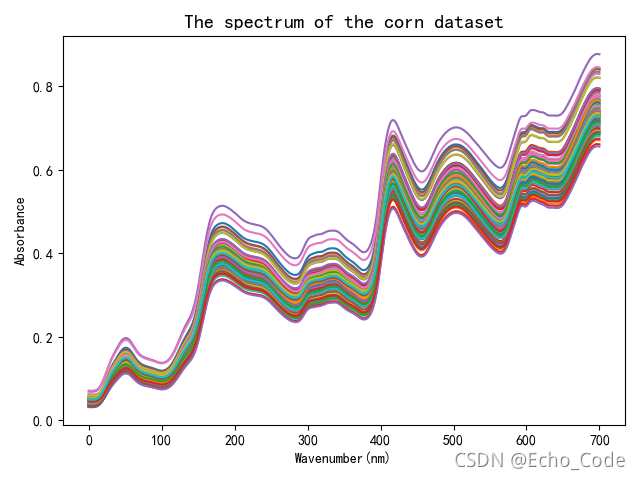
显示的光谱曲线

2.划分训练集和测试集

#随机划分数据集
x_data = np.array(data)
y_data = np.array(label[:,2])

test_ratio = 0.2
X_train,X_test,y_train,y_test = train_test_split(x_data,y_data,test_size=test_ratio,shuffle=True,random_state=2)

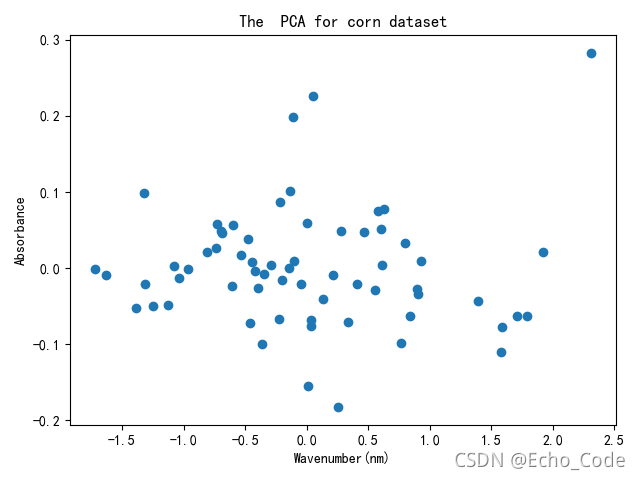
3.PCA降维并显示

#载入数据
#PCA降维到10个维度,测试该数据最好
pca=PCA(n_components=10)  #只保留2个特征
pca.fit(X_train)
X_train_reduction = pca.transform(X_train)
X_test_reduction = pca.transform(X_test)

# PCA降维后图片绘制
plt.figure(100)
plt.scatter(X_train_reduction[:, 0], X_train_reduction[:, 1],marker='o')
plt.xlabel("Wavenumber(nm)")
plt.ylabel("Absorbance")
plt.title("The  PCA for corn dataset",fontweight= "semibold",fontsize='large')
plt.savefig('.//Result//PCA.png')
plt.show()

PCA降维后的数据分布: PCA降维后的数据分布
4.建立校正模型(数据拟合)

#pls预测
pls2 = PLSRegression(n_components=3)
pls2.fit(X_train_reduction, y_train)

train_pred = pls2.predict(X_train_reduction)
pred = pls2.predict(X_test_reduction)

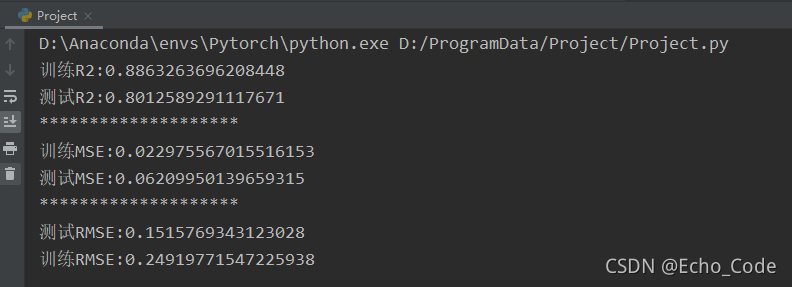
5.模型评估(使用R2、RMSE、MSE指标)

#计算R2
train_R2 = r2_score(train_pred,y_train)
R2 = r2_score(y_test,pred) #Y_true, Pred
print('训练R2:{}'.format(train_R2))
print('测试R2:{}'.format(R2))
#计算MSE
print('********************')
x_MSE = mean_squared_error(train_pred,y_train)
t_MSE = mean_squared_error(y_test,pred)
print('训练MSE:{}'.format(x_MSE))
print('测试MSE:{}'.format(t_MSE))

#计算RMSE
print('********************')
print('测试RMSE:{}'.format(sqrt(x_MSE)))
print('训练RMSE:{}'.format(sqrt(t_MSE)))

模型评估结果: 模型评估结果
6.绘制拟合差异曲线图

#绘制拟合图片
plt.figure(figsize=(6,4))
x_col = np.linspace(0,16,16)  #数组逆序
# y = [0,10,20,30,40,50,60,70,80]
# x_col = X_test
y_test = np.transpose(y_test)
ax = plt.gca()
ax.set_xlim(0,16)
ax.set_ylim(6,11)
# plt.yticks(y)
plt.scatter(x_col, y_test,label='Ture', color='blue')
plt.plot(x_col, pred,label='predict', marker='D',color='red')
plt.legend(loc='best')
plt.xlabel("测试集的样本")
plt.ylabel("样本的值")
plt.title("The Result of corn dataset",fontweight= "semibold",fontsize='large')
plt.savefig('.//Result//Reslut.png')
plt.show()

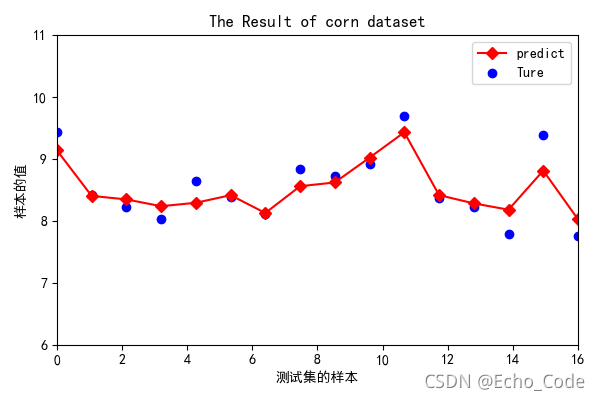
结果如图: 拟合差异曲线
Owner
Fu Pengyou
Computer graduate student, engaged in machine learning, data analysis
Fu Pengyou
Code and datasets for the paper "Combining Events and Frames using Recurrent Asynchronous Multimodal Networks for Monocular Depth Prediction" (RA-L, 2021)

Combining Events and Frames using Recurrent Asynchronous Multimodal Networks for Monocular Depth Prediction This is the code for the paper Combining E

Robotics and Perception Group 69 Dec 26, 2022
A user-friendly research and development tool built to standardize RL competency assessment for custom agents and environments.

Built with ❤️ by Sam Showalter Contents Overview Installation Dependencies Usage Scripts Standard Execution Environment Development Environment Benchm

SRI-AIC 1 Nov 18, 2021
This repository contains notebook implementations of the following Neural Process variants: Conditional Neural Processes (CNPs), Neural Processes (NPs), Attentive Neural Processes (ANPs).

The Neural Process Family This repository contains notebook implementations of the following Neural Process variants: Conditional Neural Processes (CN

DeepMind 892 Dec 28, 2022
KGDet: Keypoint-Guided Fashion Detection (AAAI 2021)

KGDet: Keypoint-Guided Fashion Detection (AAAI 2021) This is an official implementation of the AAAI-2021 paper "KGDet: Keypoint-Guided Fashion Detecti

Qian Shenhan 35 Dec 29, 2022
Anime Face Detector using mmdet and mmpose

Anime Face Detector This is an anime face detector using mmdetection and mmpose. (To avoid copyright issues, I use generated images by the TADNE model

198 Jan 07, 2023
Pytorch implementation of ProjectedGAN

ProjectedGAN-pytorch Pytorch implementation of ProjectedGAN (https://arxiv.org/abs/2111.01007) Note: this repository is still under developement. @InP

Dominic Rampas 17 Dec 14, 2022
Lexical Substitution Framework

LexSubGen Lexical Substitution Framework This repository contains the code to reproduce the results from the paper: Arefyev Nikolay, Sheludko Boris, P

Samsung 37 Sep 15, 2022
Predict halo masses from simulations via graph neural networks

HaloGraphNet Predict halo masses from simulations via Graph Neural Networks. Given a dark matter halo and its galaxies, creates a graph with informati

Pablo Villanueva Domingo 20 Nov 15, 2022
the code for our CVPR 2021 paper Bilateral Grid Learning for Stereo Matching Network [BGNet]

BGNet This repository contains the code for our CVPR 2021 paper Bilateral Grid Learning for Stereo Matching Network [BGNet] Environment Python 3.6.* C

3DCV developer 87 Nov 29, 2022
MazeRL is an application oriented Deep Reinforcement Learning (RL) framework

MazeRL is an application oriented Deep Reinforcement Learning (RL) framework, addressing real-world decision problems. Our vision is to cover the complete development life cycle of RL applications ra

EnliteAI GmbH 222 Dec 24, 2022
Hide screen when boss is approaching.

BossSensor Hide your screen when your boss is approaching. Demo The boss stands up. He is approaching. When he is approaching, the program fetches fac

Hiroki Nakayama 6.2k Jan 07, 2023
Feed forward VQGAN-CLIP model, where the goal is to eliminate the need for optimizing the latent space of VQGAN for each input prompt

Feed forward VQGAN-CLIP model, where the goal is to eliminate the need for optimizing the latent space of VQGAN for each input prompt. This is done by

Mehdi Cherti 135 Dec 30, 2022
This project provides the proof of the uniqueness of the equilibrium and the global asymptotic stability.

Delayed-cellular-neural-network This project provides the proof of the uniqueness of the equilibrium and the global asymptotic stability. There is als

4 Apr 28, 2022
A highly modular PyTorch framework with a focus on Neural Architecture Search (NAS).

UniNAS A highly modular PyTorch framework with a focus on Neural Architecture Search (NAS). under development (which happens mostly on our internal Gi

Cognitive Systems Research Group 19 Nov 23, 2022
A high-performance anchor-free YOLO. Exceeding yolov3~v5 with ONNX, TensorRT, NCNN, and Openvino supported.

YOLOX is an anchor-free version of YOLO, with a simpler design but better performance! It aims to bridge the gap between research and industrial communities. For more details, please refer to our rep

7.7k Jan 06, 2023
A supplementary code for Editable Neural Networks, an ICLR 2020 submission.

Editable neural networks A supplementary code for Editable Neural Networks, an ICLR 2020 submission by Anton Sinitsin, Vsevolod Plokhotnyuk, Dmitry Py

Anton Sinitsin 32 Nov 29, 2022
pytorch implementation of dftd2 & dftd3

torch-dftd pytorch implementation of dftd2 [1] & dftd3 [2, 3] Install # Install from pypi pip install torch-dftd # Install from source (for developer

33 Nov 28, 2022
Learning to Map Large-scale Sparse Graphs on Memristive Crossbar

Release of AutoGMap:Learning to Map Large-scale Sparse Graphs on Memristive Crossbar For reproduction of our searched model, the Ubuntu OS is recommen

2 Aug 23, 2022
MILK: Machine Learning Toolkit

MILK: MACHINE LEARNING TOOLKIT Machine Learning in Python Milk is a machine learning toolkit in Python. Its focus is on supervised classification with

Luis Pedro Coelho 610 Dec 14, 2022
Implements an infinite sum of poisson-weighted convolutions

An infinite sum of Poisson-weighted convolutions Kyle Cranmer, Aug 2018 If viewing on GitHub, this looks better with nbviewer: click here Consider a v

Kyle Cranmer 26 Dec 07, 2022